
Radical Kinship
Curated by Chloë Flores
SATURDAY, MAY 16—SUNDAY, AUGUST 2, 2026
Visit the exhibition Wed–Sat, 10AM–5PM
@FCCW: 3053 Rosslyn St. LA, CA 90065
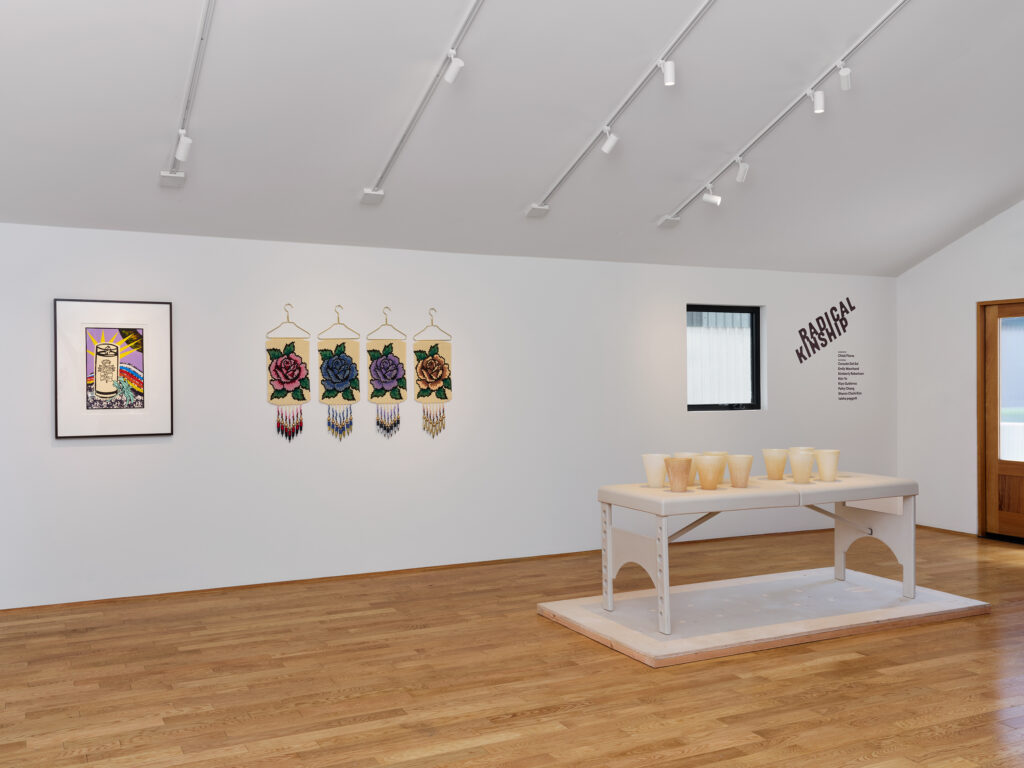
Feminist Center for Creative Work (FCCW) is proud to present our summer exhibition, Radical Kinship, curated by Chloë Flores. The show brings together eight contemporary women artists, who enact kinship as a practice of resistance, survival, and world-building. It features work from Patty Chang, Kim Ye, taisha paggett, Kimberly Robertson, Corazón del Sol, Emily Marchand, Kiyo Gutiérrez, and Sharon Chohi Kim.
Emerging from deeply feminist, queer, and Indigenous frameworks, this exhibition centers relational ways of being that counter the logics of separability, individualism, and extraction through work that is responsive to the world. Engaging with communities, traditions, and pressing social issues, the works model interdependence, reciprocity, and care as methodologies for making art and for living. Through collage, ceramic painting, sculpture, film, print, installation, and performance, the exhibition traces radical kinship across human, ancestral, and more-than-human networks.
In a time marked by climate catastrophe, political rollbacks, and deep social fragmentation, Radical Kinship insists that how we relate — across bodies, cultures, generations, and species — matters more than ever. Central to the exhibition is the artist’s refusal of separability: a commitment to relationality, embodiment, and mutual care as generative forces that challenge dominant paradigms of power and production. Kin-making is thus a political act. It asks, how can we hold each other in ways that refuse domination? And what forms of kinship might sustain us into uncertain futures?
Presented at Feminist Center for Creative Work, Radical Kinship is more than an exhibition, it’s a site of shared imagination, an activation of the ethos and values of the space, as well as the histories rooted in queer/feminist/indigenous caretaking, which each of these artists practices carry into the present and future.
At the heart of Radical Kinship is the understanding that care is not always visible, celebrated, or institutionally supported. It often emerges from necessity and community, taking place quietly through informal labor and forms of attention that hold one another up. As the exhibition’s curator, Chloë Flores notes, “I am drawn to kinship as a way of being that illuminates and insists that we are already entangled, and therefore responsible to one another. Relation is not sentimental—it is infrastructural. Radical kinship frameworks are not new; they have long existed in feminist, queer, and indigenous thought (often formed when colonial and capital systems fail us).”
Radical Kinship is made possible by support from WHH Foundation, and The Andy Warhol Foundation for the Arts, along with our members and supporters.
PUBLIC PROGRAMMING
You can find written and photo documentation of the performance works in this exhibit by Sharon Chohi Kim’s lean and Kiyo Gutierrez’s mojada, and an additional interview of Emily Marchand and Corazón Del Sol by Hadeel Boufarhat.
- Saturday, May 16 — Exhibition Preview at FCCW’s GATHER Benefit, 6–10PM @ FCCW
- Sunday, May 17 — Public Opening of Radical Kinship, 3–5PM @ FCCW
- Thursday, June 11 — lean, a performance by Sharon Chohi Kim, 6:30–9PM @ FCCW
- Wednesday, June 17 – Beading Keychains with Kimberly Robertson, 5:30–7:30PM @ FCCW
- Saturday, June 20 — Beading Session Keychains with Kimberly Robertson, 10:30AM–12:30PM @ FCCW
- Saturday, June 20 — Indigenous Perspectives on Radical Kinship: Kimberly Robertson, Corazón Del Sol & Chloë Flores, 1-2PM @ FCCW
- Wednesday, July 1 — mojada, a performance by Kiyo Gutiérrez, 7:30–9:30PM @ FCCW
- Thursday, July 23 — Curatorial Walk-Through with Kim Ye and Chloë Flores, 2–3:30PM @ FCCW
- Thursday, July 23 — Community Presentation of Kim Ye’s Sex Workers’ Guide to Parenting, followed by a panel discussion, 6–9PM @ The Kult:LA
ABOUT THE WORK + ARTISTS
Sharon Chohi Kim
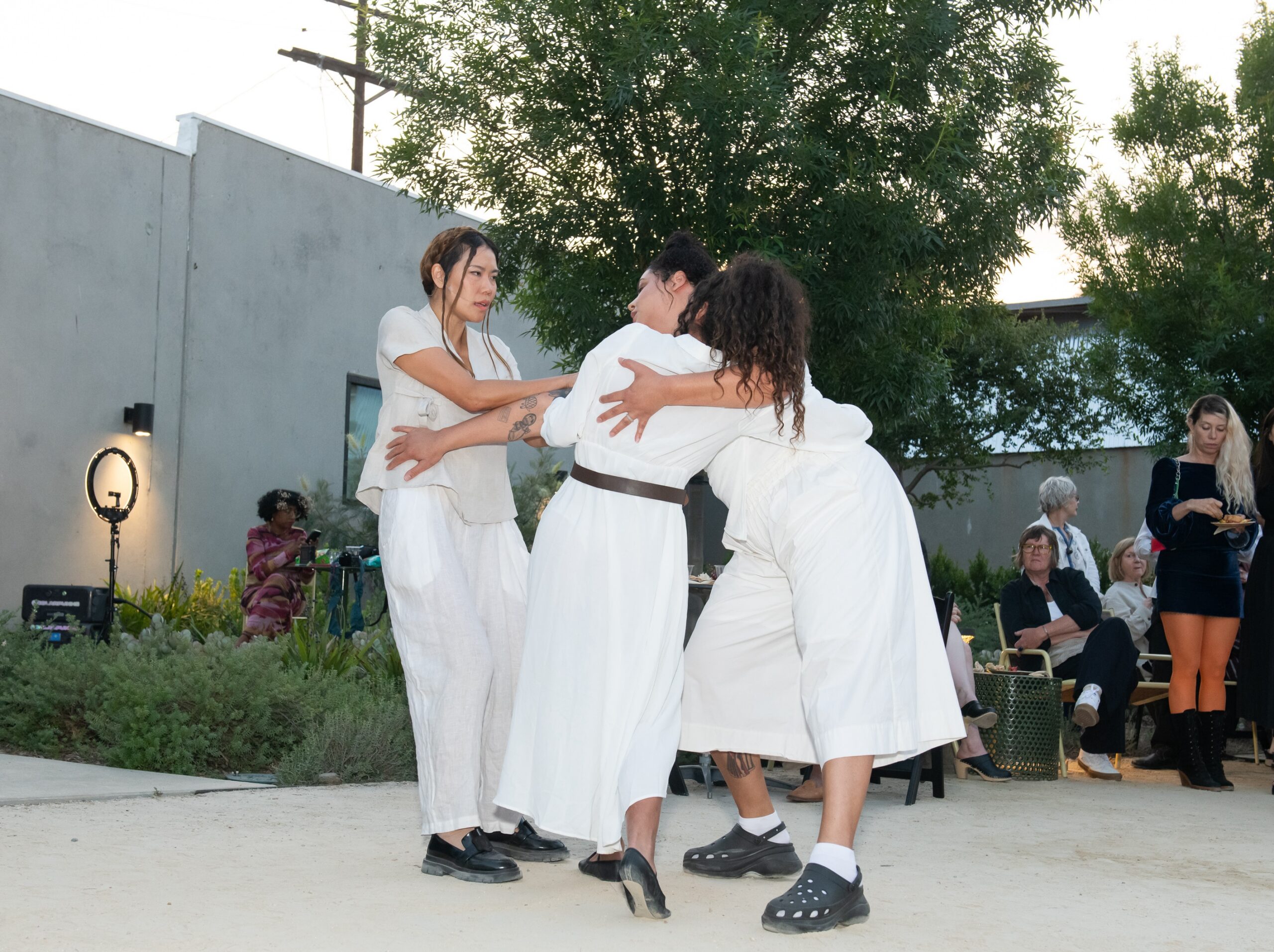
Lean, 2026
Voice-based Performance taking place Thursday, June 11, 2026 at 6PM
Performers: Mikaela Elson, Sharon Chohi Kim, Ianthe Marini, Divya Maus, Molly Pease, Rachel Steinke
Lean is a performance of voice and body. Through acts of leaning, carrying, resisting and releasing, six performers form adaptive structures of support that echo the dynamics of family systems. Weight redistribution becomes a language passed between bodies tracing how grief, joy, care, anger and addiction move through kinship networks. Resonating through matrilineal gestures and Korean bathhouse practices, the work unfolds through interwoven vocal and movement canons, like echoes across generations. It invites an embodied experience of interdependence where support is constantly negotiated and in flux.
Sharon Chohi Kim is a Los Angeles–based performing artist and composer whose work spans experimental opera, performance art, improvisation and sound installation. Described in Fjord Review for creating a “journey into worlds, physical, spiritual, philosophical and otherwise,” and praised for evoking “otherworldly sounds, seemingly bubbling up from deep within,” Kim brings an expansive, multidisciplinary approach to performance. Through voice and movement, she creates immersive, site-responsive works that explore human and nonhuman collectivity and feminist ecologies of care. Her work and collaborations have been presented by MOCA, REDCAT, LA Phil Insight, GYOPO, the Getty Villa, Hammer Museum and Long Beach Opera, among others. She is a recipient of the 2026 Creative Capital Award. She has performed in projects by Meredith Monk, Yuval Sharon, Raven Chacon, and Du Yun, among others. She is a Company and Board Member of The Industry Opera, singer at LA Master Chorale, and composer-performer with the ensemble HEX.
sharonchohikim.com
@sharonchohikim
Kim Ye
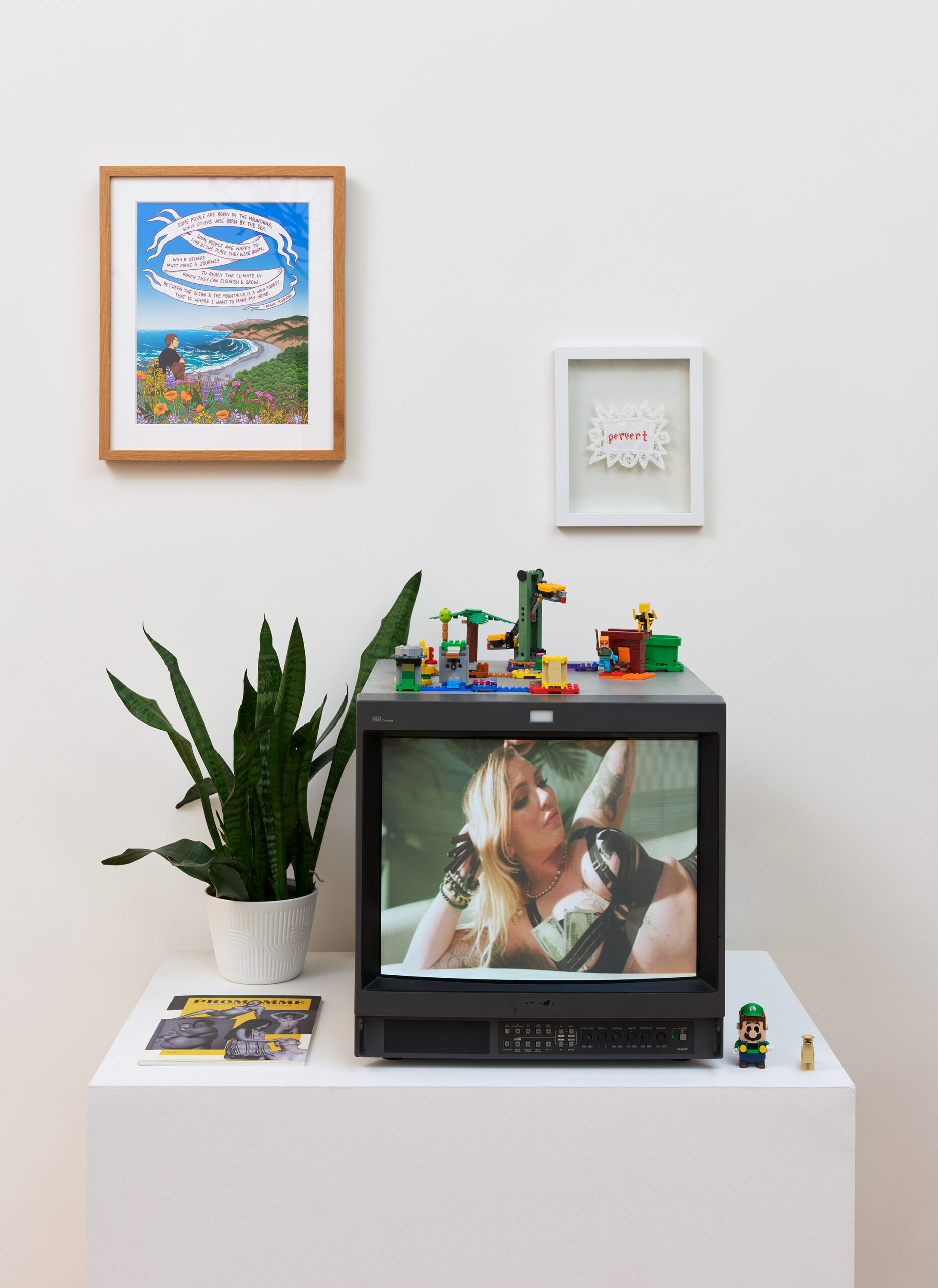
It’s not a whore house, it’s a whore home feat. The Sex Worker’s Guide to Parenting, 2026
Single-channel film installation. Running time: 39:00 min
Installation: monitor, settee, first edition Promomme: A Sex Workers Guide to Parenting, ed. Kim Ye (August 2024), framed needlepoint by Elly Dallas, Lego construction by Bradbury Streed, framed print by Maia Kobe courtesy of Lorde Destroyer.
Film directed by Kim Ye. Edited by Audrey Medrano. Sound by Jessica Fuquay. Cast includes Ella Lin, Lorde Destroyer, Lotus Lain, Sweet Rosie, Kim Ye, Sorceress Bebe, Kimberly Fuentes, and Sophia Coleman.
It’s not a whore house, it’s a whore home is a film installation that features Kim Ye’s film, The Sex Worker’s Guide to Parenting. The film takes us into the lives of 6 parents in the sex industry, and explores how their work influences the way they care for children, navigate relationships, and cultivate community. Responding to familiar narratives about sex work as a threat to “family values,” The Sex Worker’s Guide to Parenting recasts its skills as those that support intentional parenting. Staged as a retro living-room setting, the installation includes personal objects loaned by parents in the film, situating their stories within the everyday material culture of parenting, labor, and survival. The installation also includes the zine, Promomme: A Sex Worker’s Guide to Parenting, ed. Kim Ye (August 2024). The publication is a poetic and practical exploration of the intersections between erotic labor and child-rearing, challenging the societal impulse to separate Madonna from Whore. It was co-published by Sming Sming + Cash Machine + SWOPLA; designed by Sophia Coleman; with contributions from Carmen of Angeles, Emme Witt-Eden, Frenchie Stoner, Gaby G., Honey de Vil, Julia SH, Lorde Destroyer, Lucy Khan, Piggy Lu, Princess Marx, Mari V, Maxine Holloway, and Yin Q.
The film and publication were created in collaboration with Sex Workers Outreach Project Los Angeles (SWOPLA) as part of Kim Ye’s CA Creative Corps fellowship, generously supported by the California Arts Council and administered by Community Partners.
Kimberly Ye is an artist and writer whose work traverses performance, film, installation, object-making, and social engagement. Appropriating existing pop cultural forms and rituals to activate artist/viewer dynamics, Ye uses the body and personal archival materials to interrogate the gendered constructs that shape perceptions of power, labor, and taboo. The resulting work is often autoethnographic and reinterprets the forces that promote and produce normativity by enacting the entanglement between private fantasies and public forums.
Recently, she has been a Franklin Furnace Fund awardee, Mellon Arts Fellow at Stanford University, and a California Arts Council Creative Corps Fellow. Her work has been funded by the California Arts Council (USA), The National Endowment for the Arts (USA), Foundation for Contemporary Art (USA), Mellon Foundation (USA), and The Australia Council for the Arts (Australia). Her work has been featured nationally and internationally at institutions such as The Getty, MOCA, Guggenheim Gallery, Wattis Institute, Hammer Museum, Banff Center for Arts, Material Art Fair, and Frieze Film Seoul, among others. Ye received her MFA from UCLA in 2012, has worked professionally as a dominatrix since 2011, and has been on the board of Sex Workers Outreach Project Los Angeles (SWOPLA) since 2019.
@kimyekimyekimye
Kimberly Robertson
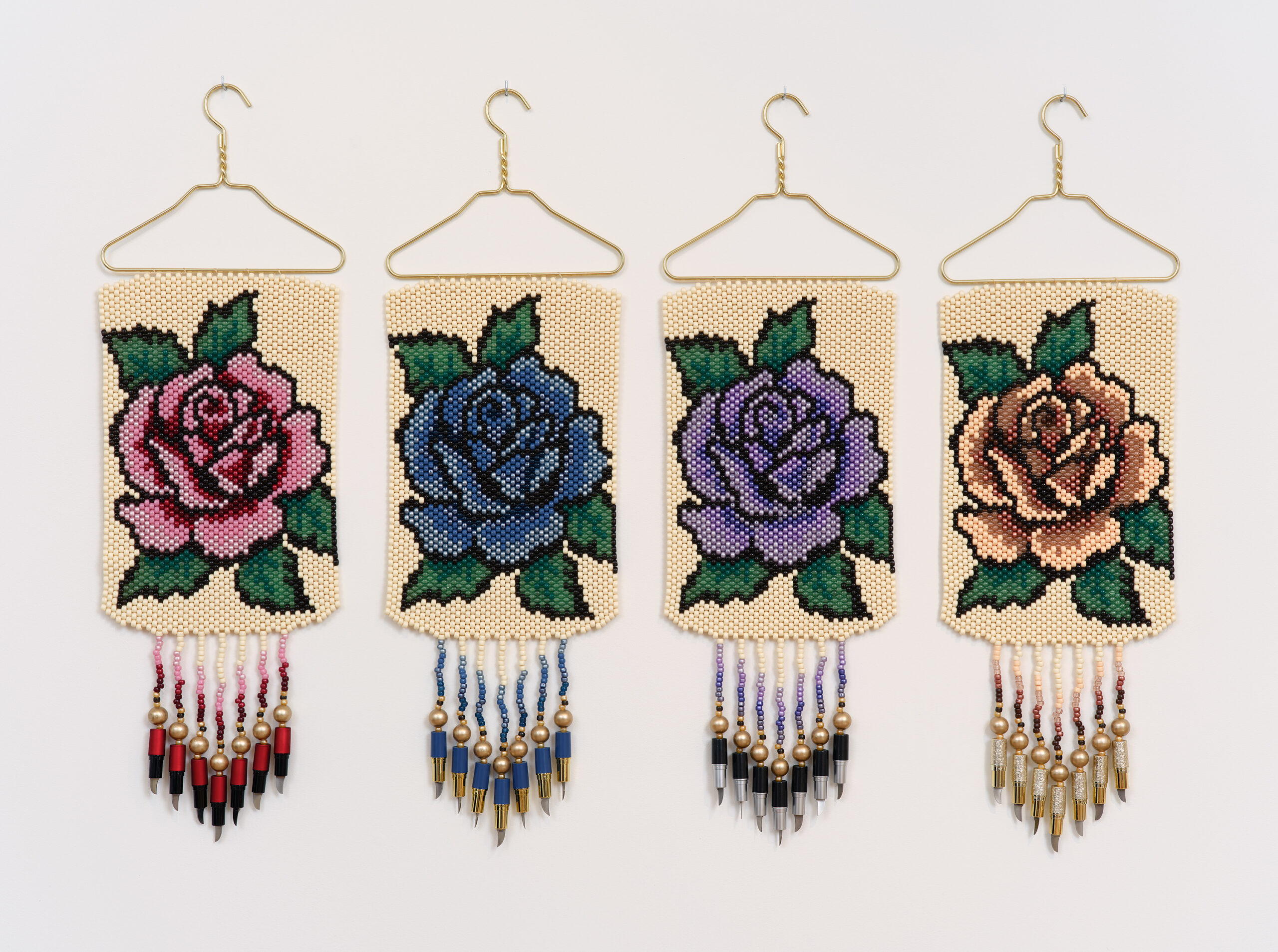
Deer Woman (pink), Deer Woman (blue), Deer Woman (purple), Deer Woman (peach), 2024
Beaded tapestries: metal hangers, plastic and wood beads, acrylic paint, lipstick knives 12 x 36” each
As a Mvskoke woman and a survivor of sexual and gender based violence, Robertson created this collection of four beaded tapestries to address the issue of violence against Native women. The work explores the tension between the beauty and the danger that comes with refusing erasure and embracing Native femme identities and expressions under settler colonialism and cisheteropatriarchy. This work celebrates the power, resiliency, and courage with which Native femmes live their lives, even in the face of murder, disappearance, and violence. The tapestries also reference the shawls that many Native women wear for cultural celebrations such as powwows and Red Shawl Day which is observed during Native American Heritage Month to raise awareness of missing and murdered Indigenous relatives.
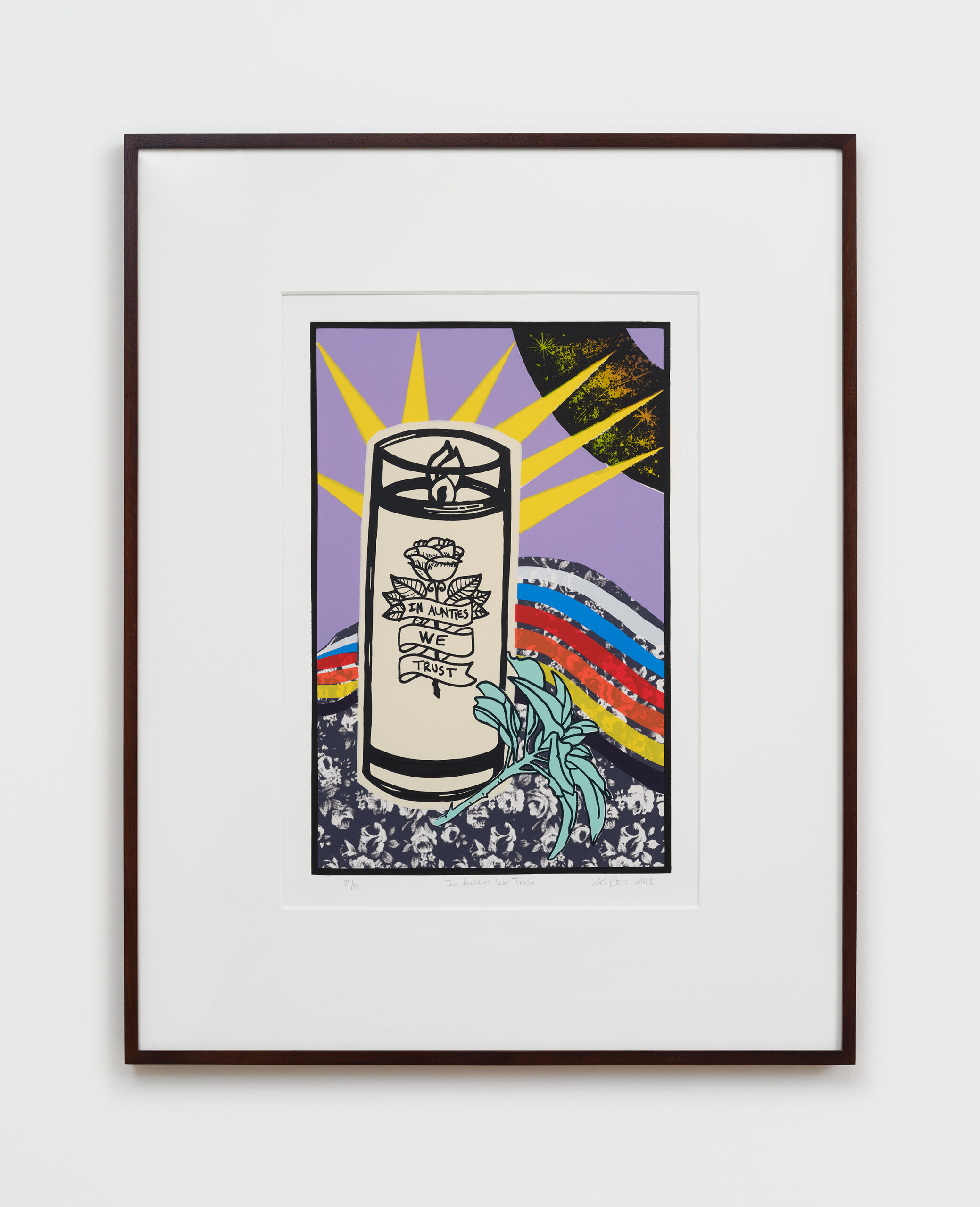
In Aunties We Trust, 2018
14-color serigraph, framed 26.75″ x 34″ (unframed 20″ x 26″)
Edition 31 of 41, published by Self Help Graphics & Art
Some people measure their wealth in fast cars and fat wallets, in fancy dinners and fine jewelry. Where Kimberly Robertson comes from, they measure wealth in aunties. Everyone knows, the stronger your tía network is, the better your chances at survival are. This print is dedicated to the auntie alliance—the posse of knowledge-wielding warriors who love us into our best selves.
Kimberly Robertson is a citizen of the Muscogee (Creek) Nation, a Professor of American Indian Studies, and a visual artist. Her scholarship and creative practices center Native feminisms, the sexual and gendered violence of settler colonialism, ceremony, storytelling, decolonization, and Indigenous futurities. Her artworks have been exhibited in numerous community, university, public, and private galleries as well as included in peer-reviewed monographs and anthologies. In the spring of 2024, The Chapter House hosted Robertson’s first solo-exhibition, Diary of a Native Femme(nist). Robertson is an active member of the Los Angeles Indian community and facilitates beading circles and art-making workshops with Tribal Nations and communities, both locally and nationally.
@kdrslaysthepatriarchy
Patty Chang
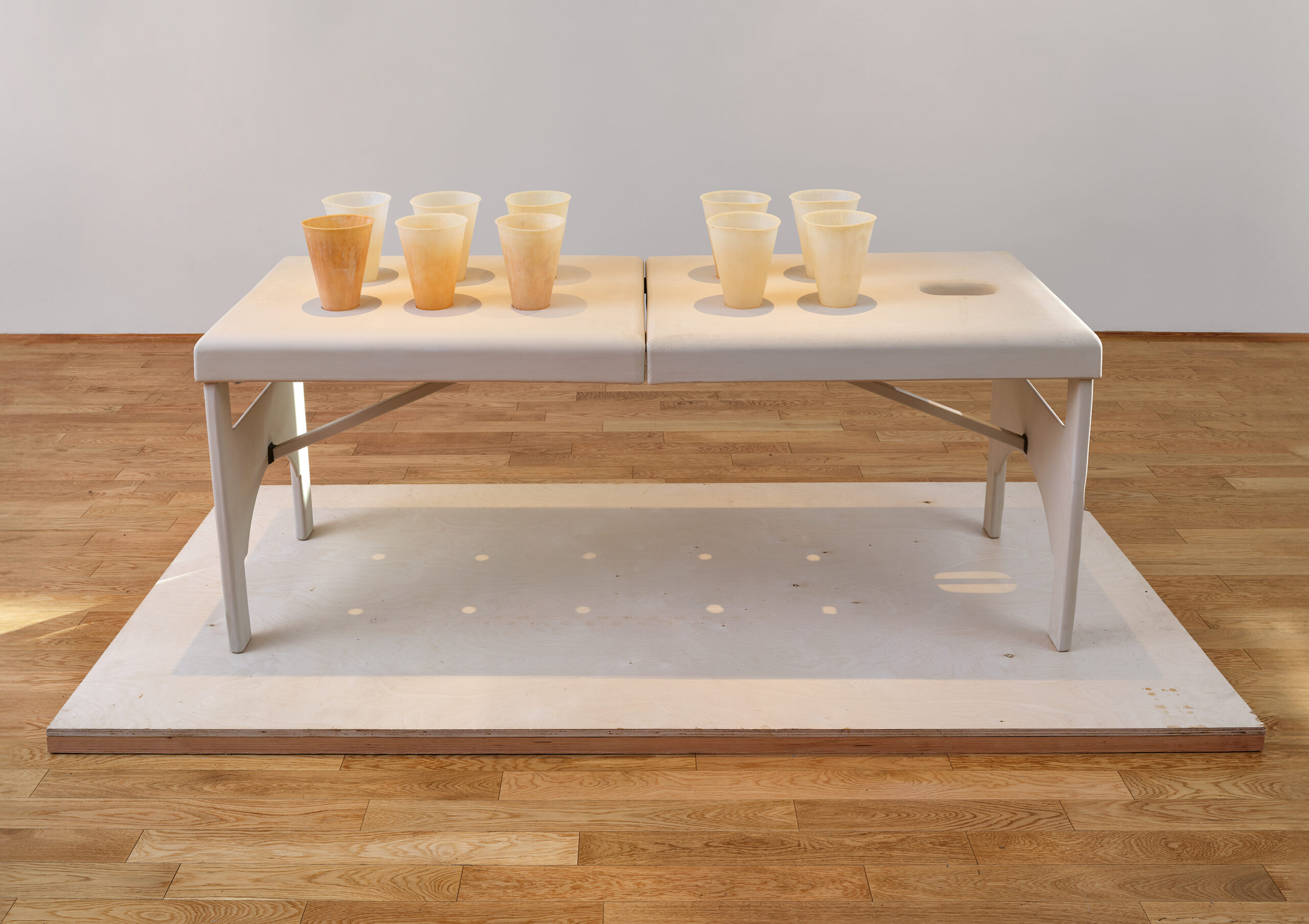
Abyssal(Primordial Pouch), 2025
Glazed and unglazed vitreous porcelain
74.75 x26.5x 28.75”
Courtesy of the artist and Kohler Co
Abyssal(Primordial Pouch) is a full-size massage table made of raw, unglazed porcelain (the underside is glazed) punctured with holes. Rather than a sturdy support for kneading a passive body, Patty Chang’s creation is an uncanny object with orifices. She writes, “The holes put the body in doubt.” Raising questions about who and what we choose to see, the work recalls the invisible labor of Asian women, including the six Atlanta spa workers murdered in 2021. Abyssal(Primordial Pouch) is also about the possibility of afterlives, regeneration, and transformation within an ecology of care with the ocean. When this exhibition closes, the table will be sunk in the Pacific Ocean, where it will serve as a deposit for growing coral. This work was made at the Kohler MakerSpace in Sheboygan, WI.
Patty Chang is a Los Angeles area based artist and educator who uses performance, video, installation, and narrative forms when considering identity, gender, transnationalism, colonial legacies, the environment, large-scale infrastructural projects, and impacted subjectivities. Learning Endings, her collaboration with Astrida and Aleksija Neimanis, is a multi-part interdisciplinary research project that surfaced amidst the overlapping contexts of climate crisis, threatened ocean ecosystems, and challenges to scientific expertise. Stray Dog Hydrophobia, her most recent project with David Kelley, explores deepsea mining and the entangled histories of extraction from the sea rooted in British colonialism in Jamaica. Kingston, Jamaica—where the British brought enslaved Africans to cultivate sugar, cocoa, and chocolate—is now home to the International Seabed Authority (ISA), the U.N. global body charged with regulating deep-sea mining. Stray Dog Hydrophobia is not only about deep-sea mining and marine life, but also about the layered violence of colonial histories and the extractive systems that endure. In addition to numerous awards and fellowships, her work has been exhibited at institutions such as the Museum of Modern Art, Guggenheim Museum, New Museum, M+ Museum in Hong Kong, and Moderna Museet in Stockholm, Sweden. She teaches at the University of Southern California in Los Angeles, CA.
Corazón del Sol
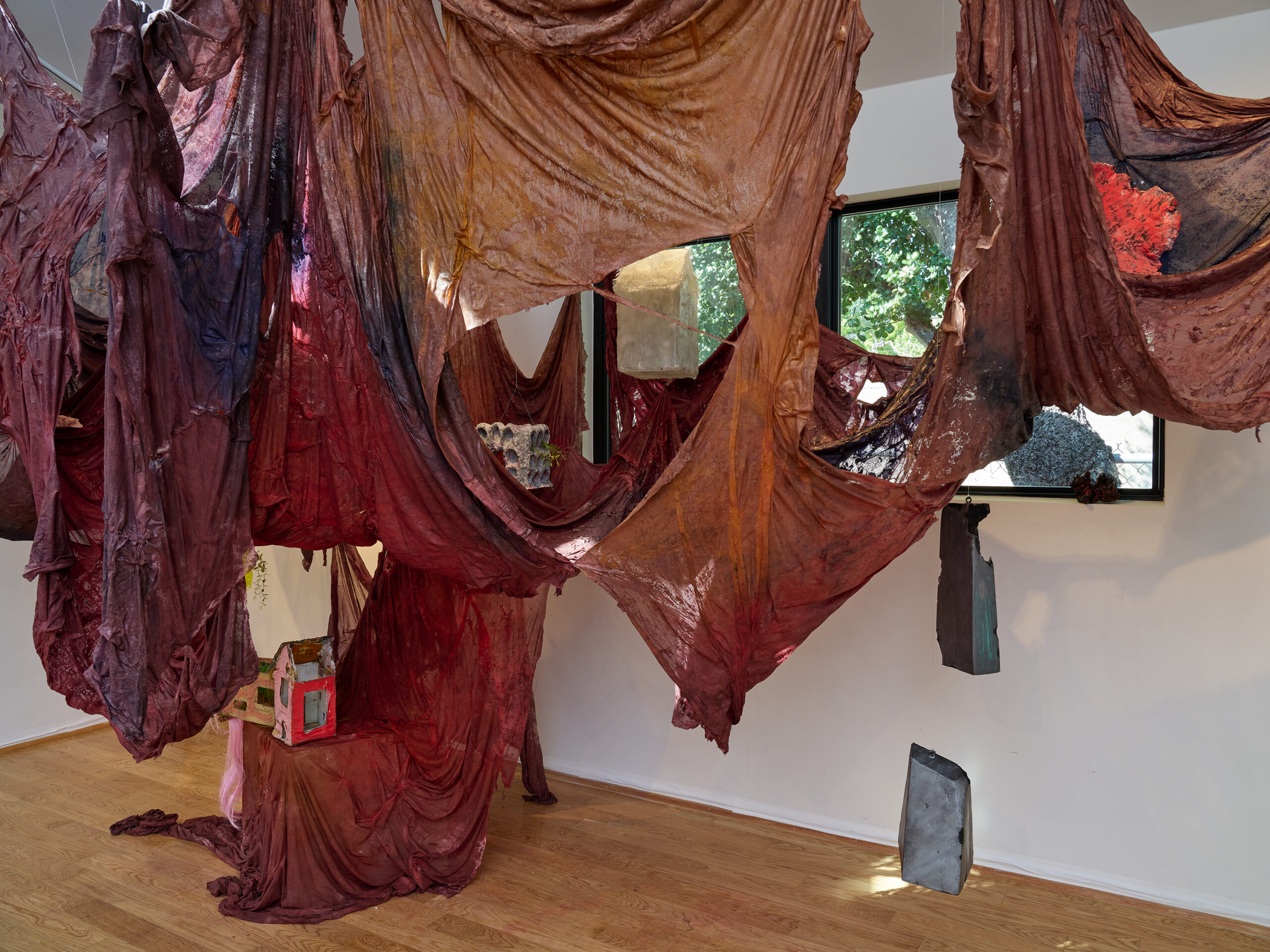
The way the light dances differently across the wall at sunset, 2026
Mixed media: Fabric, silicone, pigment, and found objects
Various sizes
The way the light dances differently across the wall at sunset is an installation of the multiplicities of home. Drawing from Indigenous understandings of relationality, the work enacts a world where all things are bound through a matrix of interconnectedness. A community of “people homes,” constructed from found objects, inhabits a landscape of translucent veils that filter light through a mycelial network of fibers, lending a dream-like texture to perception while placing us at the threshold between worlds. As a visualization of del Sol’s ongoing low-income housing project, Jardín de las Estrellas, the work imagines home not as fixed or singular, but as a collective ecology—provisional, interdependent, and shared. Here, kinship emerges through proximity, resourcefulness, and mutual presence, where shelter is shaped through relation rather than ownership.
Corazón del Sol is a Mexican Yaqui Native and third generation Los Angeles-based visual artist and activist. Informally taught by her early access to the arts and subsequent questioning of arts’ organizing systems, her practice is rooted in collective sense-making through conversation, performance, installation, video, sculpture and curatorial projects. The heart of her work is the exploration of historical traumas and their reparative solutions through collective experimental practices. For the past five years, she has been working with private and public entities on transforming our communities by creating a low-cost housing prototype within small eco communities, Jardin de Estrellas. Her work has been shown at international institutions such as Salon Nacional 44 Colombia (Colombian National Salon of Artists) and International Centre for Contemporary Culture, San Sebastian. Del Sol has curated shows including Dysfuctional Formulas of Love with co-curator Víctor Albarracín Llanos and Let Power Take a Female Form, and is represented by The Box gallery.
@delsolcorazon
Kiyo Gutiérrez
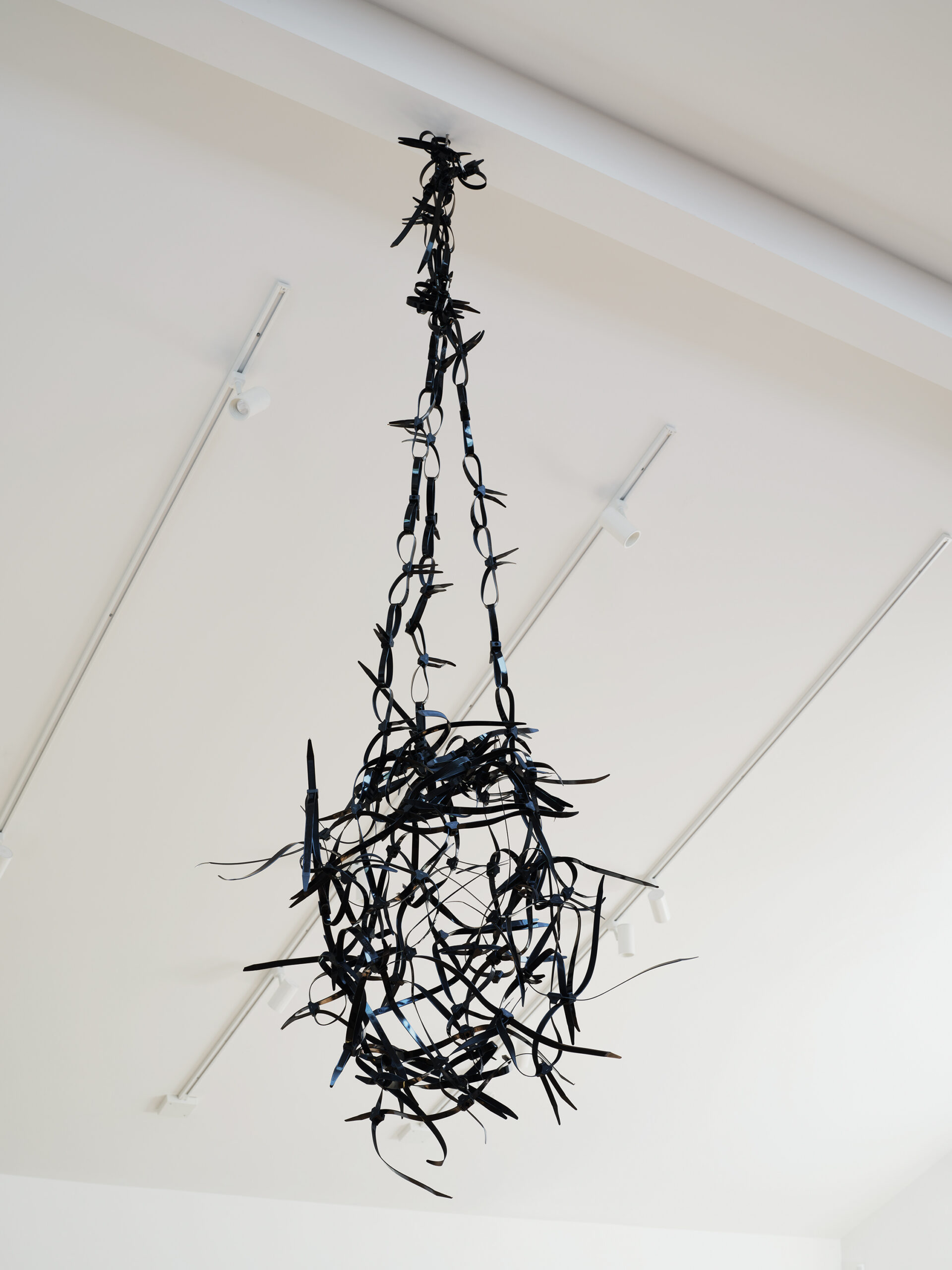
mojada, 2026
Performance taking place Wednesday, July 1, 2026 at 7:30PM
Zip-tie handcuffs, ice, tarp, maize, soil
In mojada—Spanish for “wet”—Kiyo Gutiérrez stages the body as both archive and infrastructure, bearing the sedimented histories of migration, labor, and racialized language. Drawing from Mesoamerican cosmovision, in which humans are made of maize, the work situates the body within a cosmology of land-based kinship rather than nationalist borders. Referencing the slur “wetback” and its violent immigration history, the performance transforms water from a mark of criminalization into a force of memory, endurance, and regeneration.
Special thanks to Metabolic Studio and Lauren Bon for the maize seeds from Not A Cornfield, planted on Mother’s Day 2026 within the ancestral homelands of the Gabrielino/Tongva Nation and near the Arroyo Seco. Grown from these seeds, the young maize plant appearing in mojada emerges from a longer lineage of ecological remediation and land-based practice, carrying forward ongoing cycles of cultivation, migration, and return to the land. Lauren Bon’s Not A Cornfield (2005–2006) existed for one agricultural cycle: a million kernels of corn sown, tended, and harvested to remediate a brownfield site alongside the Los Angeles River. At the time, even though water from the LA River was considered surplus and allowed to flow out to sea, California water laws prohibited diverting that water to nourish crops, extracting toxicity from the soil. That changed with Bending the River. Since 2005, Metabolic Studio has continued growing corn as an ongoing ecological and cultural practice that has helped heal soil at both Un-development 1 and Un-development 2, carrying forward the legacy of remediation, renewal, and relationship to land through each agricultural cycle.
Kiyo Gutiérrez is a Mexican multidisciplinary artist. Trained in history, she turned to performance to explore the body’s potential as a tool of resistance. Her work emerged as a response to Mexico’s brutal realities: femicide, disappearances, and environmental devastation. Her ritual-performances often integrate archival research, sculpture, textile, sound and audience participation. Her work reexamines the construction of colonial history, uncovering how bodies and materials themselves bear the traces of extraction, exploitation, resistance and transformation. She is interested in the possibility of multispecies alliances and has collaborated with damaged bodies of water, pollinators and burnt forests. Kiyo performs in public spaces and has participated in Performance Festivals and exhibitions in México, Brasil, Colombia, Bolivia, Spain, Italy and the United States. She has participated in Irrational Exhibits 13: Debates, an editorial project for Colección Cisneros, and is an alum of Georgetown University’s Laboratory for Global Performance and Politics. Kiyo is a recipient of the Franklin Furnace Fund, the Macomber Travel Grant, the Fulbright Scholarship, and was nominated for the Gilder/Coigney International Theatre Award. She received her MFA in Fine Arts at the Roski School of Arts of the University of Southern California.
kiyogutierrez.com
@kiyogutierrez
taisha paggett

common air (mirror study), 2026
Sound and video installation
common air (mirror study) is a contemplation on yielding and power, inheritance and interdependence, through sound and sight. Breath scores from friends and fellow artists, drawn from an earlier work (i believe in echoes), form a soft soundscape that invites attunement to presence and co-habitation beyond notions of identity. Tucked into the bookshelves, a video shows the trace of paggett’s exhale onto an ancestor’s mirror. As a faint vapor gathers, then disappears, a spoken mantra quietly holds the background, refiguring breath as both a reminder of impermanence and a call “to remember something larger than separateness.”
taisha paggett (they/\she) is the continuation of Cheryl Yvone McGhee Paggett, Arveal Paggett Jr, and the relatives who’ve held her. paggett respectfully resides on the original gathering lands of the Cahuilla, Tongva, Luiseño, and Serrano, colonially called Riverside, CA. paggett’s research speaks from and beyond a black, queer, insider/outsider vantage, upholding dance, choreography, and its methodologies as something to break open–a lens and lung through which to engage ideas–specifically concerning the terrain of racial trauma, grief, and manufactured identities. paggett’s a Foundation for Contemporary Arts’ Merce Cunningham Awardee and Associate Professor in Dance at UC Riverside.
itchjournal.org/taishapaggett/
@taishapaggett
Emily Marchand
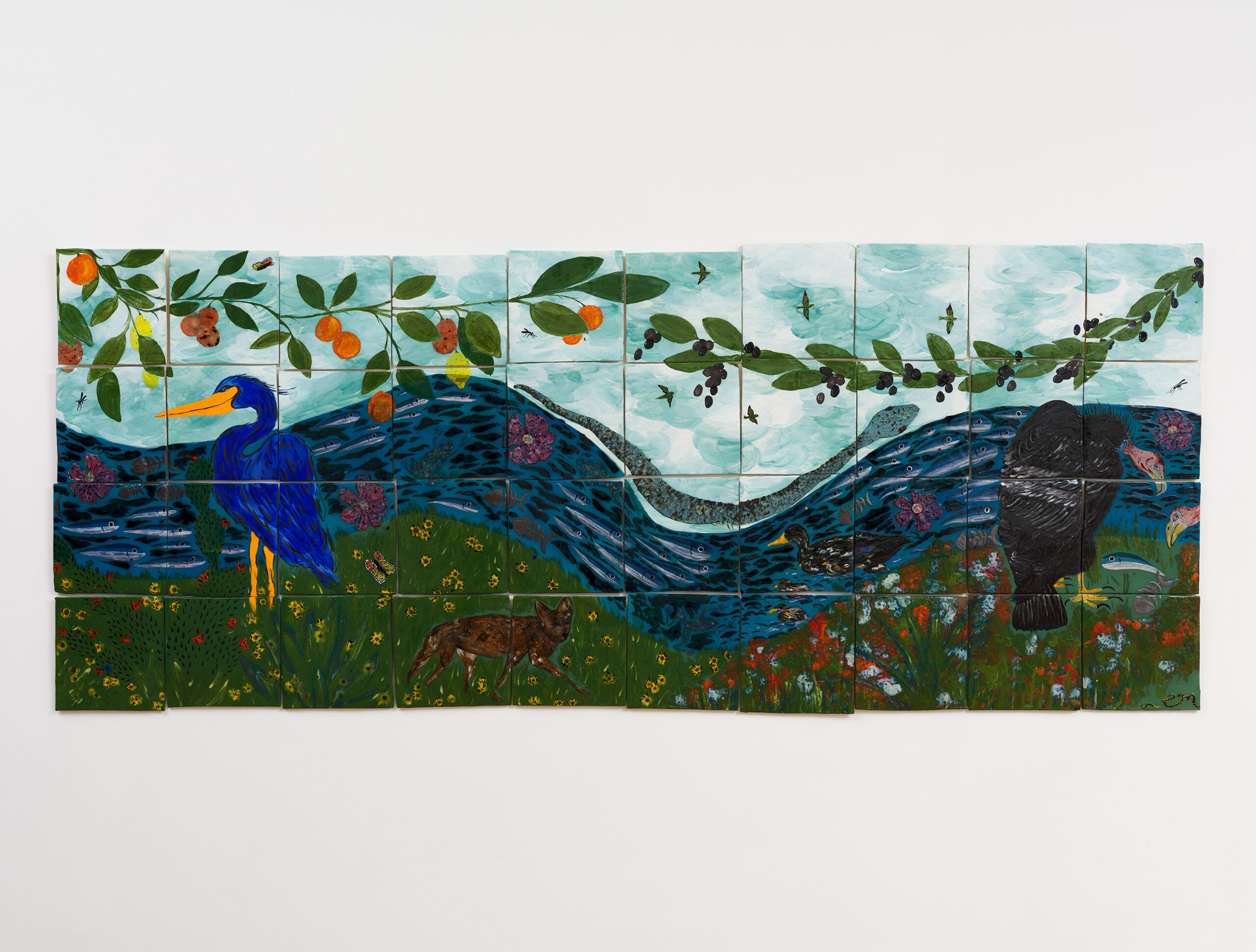
River Rat, 2026
Stoneware, glaze, underglaze
99″ x 40.5″
Drawing from formative memories along the intersection of the Sacramento and American Rivers, Marchand revisits the natural landscapes of her youth as sites where joy, loss, and emotional awareness first intertwined. In River Rat, the flowing bodies of water function as both real and symbolic spaces for refuge, reflection, and transformation. Now based in Los Angeles, Marchand extends this sensibility to the Arroyo Seco, where daily encounters with wildlife and seasonal cycles offer a quiet continuity between past and present.
River Rat diffuses emotional energy across a broader ecology of beings. Large-scale ceramic tiles depict flora and fauna imbued with the presence of those she has lost. Animals, birds, and insects become carriers of memory, their forms acting as quiet tributes to interconnected cycles of life and death. The surfaces themselves retain clear evidence of the artist’s hand, with impressions, irregularities, and subtle shifts in glaze that resist refinement in favor of immediacy, foregrounding an understanding of beauty rooted in impermanence and imperfection. It is through this human presence, gently embedded in each form, that the works accrue their emotional resonance. Grief is not anchored to one figure but instead metabolized through sustained attention to the natural world where it is dispersed, shared, and transformed into a generative force.
Emily Marchand is a LA-based artist who envelops ceramics, cooking, and community organizing in her art practice. Inspired by the native and manufactured landscapes of Los Angeles, she makes colorful forms embedded with vegetables, fruits, eggs, flora, and fauna. Her sculptures, wall works, and vessels consider tenderness and care as strategies to access a range of emotions with a timely focus on both joy and grief. What began as an investigation and exploration into Big Agriculture, seed banks, and food scarcity has inspired a closer look into her own relationship to her community through food, cooking, gardening, and feeding friends and unhoused neighbors.
www.emilymarchand.com
@emily_marchand
Chloë Flores, Curator
Chloë Flores (she/her) is a Latinx Yaqui Native curator, writer, educator, and arts leader with over twenty years of experience working in Los Angeles’ art sector. She works at the intersection of performance, place, and advocacy—foregrounding movement-based and transdisciplinary practices that interrogate power, history, and belonging. She is the director and curator of homeLA, a dance-centered organization that promotes intersectionality through site-specific programming—bridging art, architecture, and the layered histories of Los Angeles. Her work spans exhibitions, performances, programs, publications, residencies, and coalition-driven initiatives that seek to redistribute resources and generate new models for care, equity, and critical exchange.
www.chloeflores.com
Feminist Center for Creative Work
Feminist Center for Creative Work’s is a Los Angeles-based nonprofit dedicated to supporting the work of women, trans, and nonbinary artists and writers. Through exhibitions, residencies, publications, workshops, and public programs and partnerships, FCCW supports feminist and queer creative practices through ever-evolving collaborations, modeling, and resourcing the conditions for liberatory futures to take root and grow. Learn more at fccwla.org or follow us @feministcenterforcreativework.
Photos by Brica Wilcox
CURATORIAL STATEMENT BY CHLOË FLORES
Radical Kinship is an exhibition I curated for the Feminist Center for Creative Work that brings together eight contemporary women artists who enact kinship as a practice of resistance, survival, and world-building. It features work from Patty Chang, Kim Ye, taisha paggett, Kimberly Robertson, Corazón del Sol, Emily Marchand, Kiyo Gutiérrez, and Sharon Chohi Kim. Emerging from deeply feminist, queer, and Indigenous frameworks, this exhibition centers relational ways of being that counter the logics of separability, individualism, and extraction with work that is responsive to the world. Engaging with communities, traditions, and pressing social issues, the works model interdependence, reciprocity, and care as ways of relating—and of living. Through collage, ceramic painting, sculpture, film, print, installation, and performance, the exhibition traces radical kinship across human, ancestral, and more-than-human networks.
Creative kin-making has existed across centuries among non-gender binary cultures and in response to the colonial project and its state-sanctioned nuclear family. As Sophie Lewis notes in Full Surrogacy Now, “Inventive kinning has taken place in every corner of the planet ever since the institution of marriage started being forcibly imposed on poor, indigenous and colonized people.” Across feminist, queer, and Indigenous thought, this expansive understanding of kinship appears through many terms and frameworks, from Sara Ahmed’s queer and feminist family-making, to Saidiya Hartman’s “flexible and elastic kinship,” Shulamith Firestone’s “feminist kinning,” Donna Haraway’s “making kin,” and the relational worldviews articulated by Kim TallBear and Gloria Anzaldúa’s concept of mestiza consciousness. “Radical kinship” is another. I’ve encountered the term in a range of contexts, from descriptions of Father Greg Boyle and the community work of Homeboy Industries; to Madeline Lane-McKinley and Marija Cetinić’s essay on postpartum care, where radical kinship names the collective, slow labor of care that sustains life outside the logics of productivity and the nuclear family; and by Kimberly Robertson when describing her own life and art practice. The term is not mine, but I am drawn to “radical” for its earliest and contemporary senses. Derived from the Latin radix, meaning “root,” the term radical originally referred to the roots of a plant and, figuratively, to what is fundamental, essential. It paints a picture of origin and interdependence: a rhizomatic biological co-mingling of roots with what is elemental for growth—minerals, water, air, bacteria, fungi, insects. Conventionally, it has come to describe transformative political change, and in the 80s, something awesome. For me, “radical kinship” holds these meanings together: returning to the roots of relation while insisting that reimagining how we care for one another, today, is itself a radical act. Across the works in the exhibition, kinship is not understood as inherent, but as something that is cultivated. It is a living system of relations that grows across bodies, communities, ancestors, and nature.
In a time marked by climate catastrophe, political rollbacks, and deep social fragmentation, Radical Kinship insists that how we relate—across bodies, cultures, generations, and species—matters more than ever. Central to the exhibition is the artists’ refusal of separability: a commitment to relationality, embodiment, and mutual care as generative forces that challenge dominant paradigms of power and production. Kin-making is thus a political act. It asks, how can we hold each other in ways that refuse domination? And what forms of kinship might sustain us into uncertain futures?
At the heart of Radical Kinship is the understanding that care is not always visible, celebrated, or institutionally supported. It often emerges from necessity and community, taking place quietly through informal labor and forms of attention that hold one another up. Kim Ye’s documentary film Sex Workers’ Guide to Parenting reflects this precisely. It documents how sex worker parents create networks of care and stability for their children while navigating systems that criminalize or erase them. Ye’s work reveals kinship as a radical act of self-definition and mutual survival. Her 39-minute film loops on a boxy television within a retro living room mise-en-scène, complete with a couch, toys, artwork, and a plant. The installation, titled It’s not a whore house, it’s a whore home, extends the film’s visual aesthetic into physical space, inviting viewers to step into the work as an embodied and spatial experience. Personal objects loaned by parents featured in the film are woven into the installation, carrying their presence into the gallery and grounding the work in the material realities of care and home. Also on display, the first volume of Pro-Momme—a collaborative zine Ye produced with SWOP Los Angeles—further amplifies the voices of sex worker parents navigating criminalization, economic precarity, and social invisibility.
Reframing the myth of human centrality, the posthuman condition invites us to see ourselves as entangled with ecological systems, histories of extraction, and the more-than-human world. Patty Chang’s Abyssal(Primordial Pouch) reckons with these historical and material conditions of entanglement. A life-sized massage table made of unglazed and glazed porcelain draws from the colonial history of porcelain trade, referencing Asian women and sex-trade as well as the countless shipwrecks that scattered porcelain across ocean floors during transport from Asia to Europe and later to California’s coastline. Chang’s Abyssal(Primordial Pouch) reimagines the object not as a luxury item, but as a vessel of submerged histories: of migration, desire, and imperial exchange. After the exhibition, Abyssal(Primordial Pouch) will be placed on the ocean floor, where it will transform into substrate and habitat for marine life to root and grow. In this gesture, Chang links global trade to environmental restoration, and asks what it means to relinquish human possession in favor of reciprocity with the sea, tracing how colonial trade, extraction, and migration remain embedded in the object world and its afterlives.
Extending this consideration of more-than-human entanglement into a continuum, Emily Marchand approaches kinship through local river ecologies and her personal experience with loss. Her large-scale ceramic painting, River Rat, situates us within a cosmology of interdependence. Drawing from rivers in both Northern and Southern California, she envisions a flourishing riparian landscape where distinct habitats converge across time, and where animals, plants, and waterways are animated by and imbued with the spirits of animals and loved ones. Grief is subtle, not representative. Live fish swing alongside their bony ancestors suggesting that death transforms into continuity. Though humans are absent from the landscape, the work reveals how deeply humanity and nature remain entangled. The California condors—a species brought to the brink of extinction through human intervention and sustained today through human care and ecological stewardship—insist that survival itself is relational.
This expanded understanding of kinship continues in Corazón del Sol’s work where kinship emerges through animistic philosophies that reflect a transcendent connection between physical, material, and spiritual worlds. The way the light dances differently across the wall at sunset is a new conceptual work from del Sol’s Veils series that visualizes her on-going affordable housing-advocacy project, Jardin des Estrellas, through an Indigenous Yaqui lens. Translucent, webbed membranes of fabric and silicone form a visceral backdrop for a constellation of “people homes:” personified, non-capitalist homes, each hand-constructed from salvaged and repurposed materials. Lit from behind, the thin veil positions us at the threshold between realms where objects, the land, and humans share a common psychic life. The sculptural dwellings evoke the raw immediacy of a child’s drawing of home, their asymmetry and fragility standing in stark contrast to the pristine, securitized house of settler fantasy. They are homes shaped through ways of dwelling untouched by colonial logics of order, property, and permanence. They appear precarious yet their provisional quality does not negate their vitality. Their anthropomorphic gestures (like tufts of synthetic hair and windowed-eyes) tell us otherwise. This is an alternate shelter: one built with shared resources that is alive and ensouled. The way the light dances… asserts housing is not only a policy issue, but also a question of how we imagine belonging.
Kimberly Robertson’s artworks similarly emerge from her embodied experiences as a Mvskoke woman and are deeply rooted in Indigenous feminist methodologies. Her work honors a kinship that extends beyond bloodlines, which is especially vital for those whose ancestral ties have been fractured by colonial displacement. Her collage-based work includes screenprinting and beadwork imbued with symbolic imagery of indigenous support systems across generations and spiritual realms. In Aunties We Trust pays homage to the auntie network—a “posse of knowledge-wielding warriors” who, in her words, “love us into our best selves.” The serigraph features ribbon skirts (celebrations of Native femme identity), sage bundles (tools of sacred cleansing), and other representations of intergenerational care. Deer Woman also honors a defender: a powerful figure from Native mythology who crosses between worlds to defend women and children against violence. A collection of beaded tapestries depict a rose—symbol of beauty and resistance—hanging from a wire hanger, while lipstick knives transform femme-coded adornment into protective force. In Robertson’s work, spirit and material converge in a space of interconnection, where the past moves through the present, and ancestral protectors walk alongside the living in a quantum time, unwedded to capitalism.
Amid the collapse of time and interwoven worlds of the exhibition, taisha paggett’s new sound and video installation opens a hush—a somatic invitation toward interiority and the shared rhythms of life moving through and around all of us. In their own words, common air (mirror study) is a “contemplation on yielding and power, inheritance and interdependence, through sound and sight.” As the quietest and most intimate articulation of kinship in the exhibition, the work is subtly situated within the space through ambient audio recordings and an inconspicuous video that attunes us to breath. Known for her choreographic investigations into race, embodiment, and spatial politics, paggett frames breath as our shared life force. Breath connects humans, animals and plants. It links the body to the earth and atmosphere. It exists beyond identity, politics, or difference. It is, for taisha paggett, our meta-commonality.
What begins as an intimate meditation on breath unfolds outward into the atmosphere of the exhibition. Paggett’s recordings circulate through the Feminist Center (which itself resists the isolating logic of the white cube), becoming part of the shared air moving between bodies and the artworks. Within this setting, artworks are installed in close relation; one cannot encounter a single work without also experiencing another. Drifting between artworks like connective tissue, paggett’s soundscape further attunes us to the relational dynamics of the exhibition design.
As paggett’s installation draws the gallery into shared rhythms of breath and relation, Sharon Chohi Kim and Kiyo Gutiérrez extend these concerns into the live body. Their performances are temporal installations that activate kinship through embodied practice shaped through labor, reciprocity, endurance, and care.
In Sharon Chohi Kim’s lean, radical kinship emerges through the body as acts of holding, carrying, and mutual support. In this new voice-based performance, six performers lean into, carry, and rub one another, forming shifting structures of support that echo the uneven balance of family systems. Weight is redistributed across bodies—sometimes smoothly, sometimes messily—revealing interdependence as a lived negotiation rather than a stable condition. Sonically, layered vocalizations move between performers like inherited gestures, tracing how grief, joy, care, anger, and resilience circulate through kinship networks. Drawing from Korean bathhouse practices and matrilineal gestures, the work centers touch as a form of communication and care, where the act of rubbing becomes both maintenance and mutual tending. In this shared choreography of holding and being held, Kim proposes kinship as adaptive and relational, formed through shifting burdens, negotiated support, and the continual balancing required to sustain one another.
In mojada, a new ritual-performance by Kiyo Gutiérrez, the body is staged as a site of kinship that holds lineages and sustains collective survival. Drawing from Mesoamerican cosmovision in which humans are understood as beings of maize, Gutiérrez reclaims the back—marked by the slur “wetback”—as a site of cultivation rather than criminalization. In this durational performance, Gutiérrez crouches with her bare back under a block of ice that is suspended from a black zip-tie handcuff basket, a corn seedling planted on her spine. As the ice melts, frigid drops trace down her body and onto the floor, pooling around her. She endures the violence of punitive immigration policy and bears the weight of the sedimented histories of migration, labor, and racialized language to sustain the life of the corn. A land-based reciprocity unfolds. With a return of the seedling to soil, Gutiérrez’s becomes an invocation—calling forth growth, prosperity, and future life.
In this moment of political polarity, cold immigration policy, and the erosion of public infrastructures of care, I am drawn to kinship as a way of being that illuminates and insists that we are already entangled, and therefore responsible to one another. Relation is not sentimental—it is infrastructural.
Radical kinship frameworks are not new; they have long existed in feminist, queer, and indigenous thought (often formed when colonial and capital systems fail us). The Feminist Center for Creative Work stands as an inheritor and container of these lineages, with aspirations rooted in collective survival and relational world-making. Spaces like FCCW—where we gather, create, and find one another through art—are political spaces, not unlike the ballroom and queer clubs that catalyzed new forms of care, belonging, and shared identity in the 80s and 90s. In these contexts, collective life was not supplementary to culture, but foundational to it. Art shaped these worlds then, as they continue to now, carried forward by contemporary artists. Within this context, Radical Kinship is more than an exhibition. It is the collective activation of an ethos shared between curator, artists, and FCCW: an ethos that emerges from our common histories of queer, feminist, and indigenous caretaking. Radical Kinship extends these practices into the present to position the gallery as a site of shared imaginations—for us, and audiences, together.
-Chloë Flores