
Thursday, July 23, 6–9PM
The Kult:LA:
251 Main St, Los Angeles, CA 90012
Max Participants: 200
Event is 21+
Free
Parking nearby ranges from $8-12, we suggest carpooling, rideshare, and taking transit!
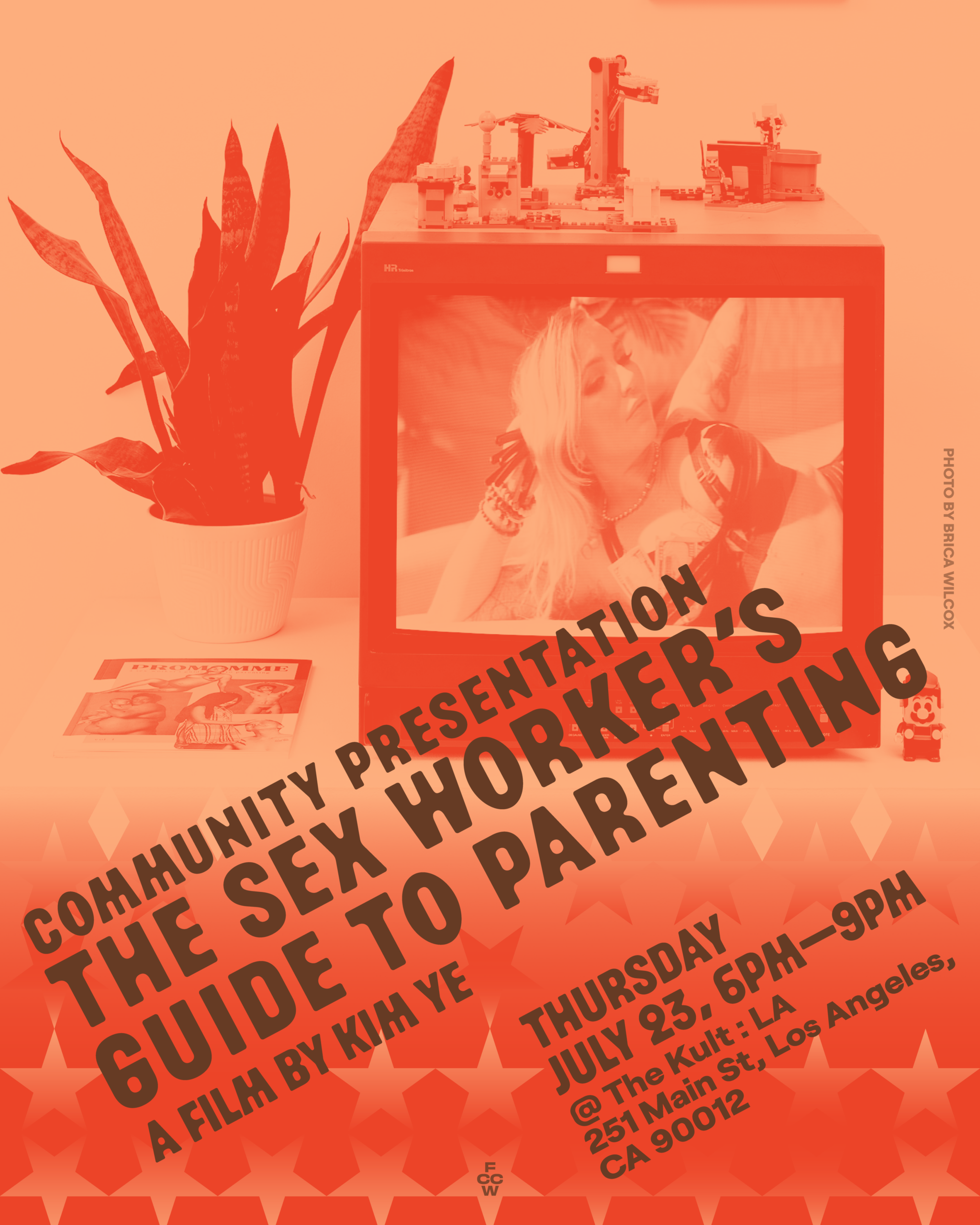
As an extension of Kim Ye’s work It’s not a whore house, it’s a whore home feat. The Sex Worker’s Guide to Parenting on view as part of Radical Kinship, we’re hosting a community screening of the film. Please join us at The Kult:LA for an evening that will include tabling by local organizations, including SWOPLA , a screening of the film, followed by a post-screening discussion with Kim Ye, Lauren Levitt, and Lotus Lain, as well as a reception with drinks and snacks in the lobby. You’ll also be invited to check out the ProMomme zine, a community-driven publication and cultural project created by Kim Ye, which centers the experiences of people who are both sex workers and parents.
If you’d like to join us for a walk-through of the Radical Kinship exhibit at Feminist Center for Creative Work with Kim Ye and Chloë Flores, you can join us on Thursday at 2PM and RSVP here.
Program Schedule
6:00–6:30PM — Arrival and Tabling
6:30–7:10PM — Screening
7:15–8:00PM — Conversation
8:00–9:00PM — Reception and Tabling
ABOUT THE FILM
The Sex Worker’s Guide to Parenting is a feature documentary rooted in the Los Angeles sex worker community. The film centers six parents working in the sex industry, including filmmaker Kimberly Ye, as they reflect on the overlapping demands of erotic labor, caregiving, secrecy, survival, and mutual support. Through intimate interviews, small group conversations, observational material, and animated reenactments, the project examines how parents in stigmatized and criminalized lines of work create family life on their own terms.
The timeline of the film follows the making of ProMomme, a parenting magazine developed by and for sex workers. Through interviews with sex work researchers and organizers, we learn that this magazine emerged from community-led research by sex workers themselves, who conducted focus groups where parents spoke openly about childcare, disclosure, emotional labor, financial survival, boundaries, and fear of custody loss. The film’s production recreated the focus group setting by staging a group conversation between the six subjects of the film, asking them the same questions that researchers asked parents in the original focus group study. The magazine both acts a character in the film by moving the plot forward towards its publication, and as a structural element, moving between vignettes of individual parent’s stories and scenes of collective organizing and exchange.
Each participant offers different relationships to parenting, labor, and public exposure. Some are “out” about their work, while others are not due to the ages of their children, custody concerns, internalized shame, family dynamics, or the threat of social punishment. Most describe erotic labor as giving them flexibility, income, and tools for communication that strengthen their caregiving, while also describing the emotional nuances of living under surveillance, the pressure to provide socially-acceptable explanations of their job, and the isolation that sex work stigma can impose on family life.
The film is driven by the voices and experiences of the parents themselves, who include 1) Sorceress Bebe, a financial dominatrix who works online and in person, for whom sex work was a way out of an abusive relationship; 2) Lorde Destroyer, a trans man Dom who specializes in hypnosis and whose cis male co-parent is the primary caregiver, 3) Ella Lin, an escort and sugar baby who raises two daughters with split custody, 4) Lotus Lain, a porn performer and adult industry advocate who organizes for better working conditions in porn knowing that her non-binary 16-year-old could end up in the industry, 5) LR, a single-mother to a 3-year old who participates in the documentary anonymously and struggles with internalized shame about her work and 6) Filmmaker Kimberly Ye who raises her small toddlers with her husband under the same roof as her BDSM dungeon where she sees clients.
Formally, the project combines documentary footage, family video, and intimate interviews with animated reenactments that give shape to scenes, memories, fears, and emotional states that cannot or should not be captured directly. These sequences are especially important in relation to privacy for participants’ children and family members, and they open a visual language for interiority that observational footage alone cannot provide. The film uses animation not simply as illustration, but as an expansive way into the subjects’ psychic space so that the view can see the world from their point of view.
This project was funded by Kim Ye’s California Creative Corps fellowship generously supported by the California Arts Council and administered by Community Partners
ABOUT THE ARTISTS
Kimberly Ye is an artist whose interdisciplinary research-based practice produces films, performances, writings, and installations rooted in her communities. As a queer first-generation Chinese American, longtime worker in the sex industry, and mother of two, she makes work for and with people whose lives are routinely misrepresented–using humor, autofiction, and pop cultural aesthetics to translate marginalized experiences into mainstream visual language. Currently, she lives between Ho Chi Minh City and Los Angeles, organizes with sex workers at SWOPLA, and slaves alongside her subbyhubby beneath their three and five-year-old. Her writings can be found at Ladyscumbag.substack.com
Lauren Levitt (all pronouns) is a postdoctoral researcher at the XCITE Center for Teaching and Learning at the University of California Riverside. Her book, Sex Worker Solidarity: Networks of Caring and Sharing – forthcoming on NYU Press – examines how sex workers and sex worker organizers in New York and Los Angeles develop non-biological kinship structures and engage in non-capitalist caring and sharing practices to manage precarity, stigma, and criminalization. Their current project explores how sex workers create cultural content to represent themselves, build community, and organize politically. Lauren is on the editorial board of The Journal of Femininities and the advisory board of the Sex Workers Outreach Project Los Angeles, and she regularly acts as a sex worker advocate at public and academic events and in the media.
Lotus Lain is a globally recognized influential public figure in the realms of consent, sex worker’s rights, self advocacy & intimacy. Throughout her 12+ year career she’s been a Dominatrix; Hall of Fame Adult Performer; a Published Writer, Guest Speaker, Producer and now Intimacy Coordinator for Mainstream TV and Film. Lotus has appeared at SXSW and on Showtime and Netflix for her work. Most recently, Lotus has spoken at the UN in Geneva and New York to inform the Human Rights Committee of the US Government’s failures to prevent trafficking and discrimination against people of LGBTQ identity.