
COMING SOON TO FCCW…
Radical Kinship
Curated by Chloë Flores
SATURDAY, MAY 16—SUNDAY, AUGUST 2, 2026
3053 Rosslyn St. Los Angeles, CA 90065
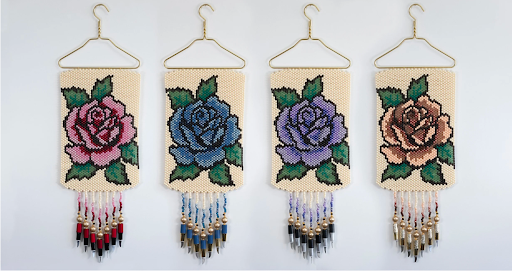
Kimberly Robertson, Deer Woman (pink), Deer Woman (blue), Deer Woman (purple), Deer Woman (peach), 2024. Courtesy of the artist.
Feminist Center for Creative Work (FCCW) is proud to present our summer exhibition, Radical Kinship, curated by Chloë Flores. The show brings together eight contemporary women artists, who enact kinship as a practice of resistance, survival, and world-building. It features work from Patty Chang, Kim Ye, taisha paggett, Kimberly Robertson, Corazón del Sol, Emily Marchand, Kiyo Gutiérrez, and Sharon Chohi Kim.
Emerging from deeply feminist, queer, and Indigenous frameworks, this exhibition centers relational ways of being that counter the logics of separability, individualism, and extraction through work that is responsive to the world. Engaging with communities, traditions, and pressing social issues, the works model interdependence, reciprocity, and care as methodologies for making art and for living. Through collage, ceramic painting, sculpture, film, print, installation, and performance, the exhibition traces radical kinship across human, ancestral, and more-than-human networks.
In a time marked by climate catastrophe, political rollbacks, and deep social fragmentation, Radical Kinship insists that how we relate — across bodies, cultures, generations, and species — matters more than ever. Central to the exhibition is the artist’s refusal of separability: a commitment to relationality, embodiment, and mutual care as generative forces that challenge dominant paradigms of power and production. Kin-making is thus a political act. It asks, how can we hold each other in ways that refuse domination? And what forms of kinship might sustain us into uncertain futures?
Presented at Feminist Center for Creative Work, Radical Kinship is more than an exhibition, it’s a site of shared imagination, an activation of the ethos and values of the space, as well as the histories rooted in queer/feminist/indigenous caretaking, which each of these artists practices carry into the present and future.
At the heart of Radical Kinship is the understanding that care is not always visible, celebrated, or institutionally supported. It often emerges from necessity and community, taking place quietly through informal labor and forms of attention that hold one another up. As the exhibition’s curator, Chloë Flores notes, “I am drawn to kinship as a way of being that illuminates and insists that we are already entangled, and therefore responsible to one another. Relation is not sentimental—it is infrastructural. Radical kinship frameworks are not new; they have long existed in feminist, queer, and indigenous thought (often formed when colonial and capital systems fail us).”
Radical Kinship is made possible by support from WHH Foundation, and The Andy Warhol Foundation for the Arts, along with our members and supporters.
PUBLIC PROGRAMMING
- Saturday, May 16 — Exhibition Preview at FCCW’s GATHER Benefit, 6–10pm @ FCCW
- Sunday, May 17 — Public Opening of Radical Kinship, 3–5pm @ FCCW
- Thursday, June 11 — lean, a performance by Sharon Chohi Kim 6:30–9pm @ FCCW
- Wednesday, June 17 – Keychain Beading Session and Land Acknowledgement Zine Workshop with Kimberly Robertson, 5:30–7:30pm @ FCCW
- Saturday, June 20 — Keychain Beading Session and Land Acknowledgement Zine Workshop with Kimberly Robertson, 10:30–12:30pm @ FCCW
- Wednesday, July 1 — mojada, a performance by Kiyo Gutiérrez, 7:30–9:30pm @ FCCW
- Details to be announced — Community Presentation of Kim Ye’s Sex Workers’ Guide to Parenting, followed by a panel discussion.
WORKS IN THE EXHIBITION
Kim Ye’s documentary film Sex Workers’ Guide to Parenting reflects how sex worker parents create networks of care and stability for their children while navigating systems that criminalize or erase them. Reframing the myth of human centrality, the posthuman condition invites us to see ourselves as entangled with ecological systems, histories of extraction, and the more-than-human world.
Patty Chang’s Abyssal reckons with the historical and material conditions of human entanglement with the natural world. A life-sized massage table made of unglazed porcelain draws from the colonial history of porcelain trade, referencing Asian women and sex-trade as well as the countless shipwrecks that scattered porcelain across ocean floors during transport from Asia to Europe and later to California’s coastline.
Emily Marchand approaches kinship through local river ecologies and her personal experience with loss. Her large-scale ceramic painting River Rat situates the human within a cosmology of interdependence.
Corazón del Sol’s work explores where kinship emerges through animistic philosophies that reflect a transcendent connection between physical, material, and spiritual worlds. The way the light dances differently across the wall at sunset is a new installation from del Sol’s Veils series that visualizes her on-going affordable housing-advocacy project, Jardin des Estrellas, through an indigenous Yaqui lens.
Kimberly Robertson’s artworks emerge from her embodied experiences as a Mvskoke woman and are deeply rooted in Indigenous feminist methodologies. Her collage-based work includes screenprinting and beadwork imbued with symbolic imagery of indigenous support systems across generations and spiritual realms. In Aunties We Trust pays homage to the auntie network—a “posse of knowledge-wielding warriors” who, in her words, “love us into our best selves.” Deer Woman also honors a defender: a powerful figure from Native mythology who crosses between worlds to defend women and children against violence.
taisha paggett’s new multi-media installation opens a hush—a somatic invitation toward interiority and the shared rhythms of life moving through and around us. In their own words, common air (mirror study) is a contemplation on yielding and power, inheritance and interdependence, through sound and sight.
In Sharon Chohi Kim’s lean, radical kinship similarly emerges through the body—this time through acts of holding, carrying, and mutual support. In this new voice-based performance, six performers lean into, carry, and rub one another, forming shifting structures of support that echo the uneven balance of family systems.
In mojada, a new ritual-performance by Kiyo Gutiérrez, the body is staged as a site of kinship that holds lineages and sustains collective survival. Drawing from Mesoamerican cosmovision in which humans are understood as beings of maize, Gutiérrez reclaims the back—marked by the slur “wetback”—as a site of cultivation rather than criminalization.
ABOUT THE ARTISTS
Sharon Chohi Kim
https://sharonchohikim.com
@sharonchohikim
Sharon Chohi Kim is a Los Angeles–based performing artist and composer whose work spans experimental opera, performance art, improvisation and sound installation. Described in Fjord Review for creating a “journey into worlds, physical, spiritual, philosophical and otherwise,” and praised for evoking “otherworldly sounds, seemingly bubbling up from deep within,” Kim brings an expansive, multidisciplinary approach to performance. Through voice and movement, she creates immersive, site-responsive works that explore human and nonhuman collectivity and feminist ecologies of care. Her work and collaborations have been presented by MOCA, REDCAT, LA Phil Insight, GYOPO, the Getty Villa, Hammer Museum and Long Beach Opera, among others. She is a recipient of the 2026 Creative Capital Award. She has performed in projects by Meredith Monk, Yuval Sharon, Raven Chacon, and Du Yun, among others. She is a Company and Board Member of The Industry Opera, singer at LA Master Chorale, and composer-performer with the ensemble HEX.
Kim Ye
Kimye.com
@kimyekimyekimye
Kimberly Ye is an artist and writer whose work traverses performance, film, installation, object-making, and social engagement. Appropriating existing pop cultural forms and rituals to activate artist/viewer dynamics, Ye uses the body and personal archival materials to interrogate the gendered constructs that shape perceptions of power, labor, and taboo. The resulting work is often autoethnographic and reinterprets the forces that promote and produce normativity by enacting the entanglement between private fantasies and public forums.
Recently, she has been a Franklin Furnace Fund awardee, Mellon Arts Fellow at Stanford University, and a California Arts Council Creative Corps Fellow. Her work has been funded by the California Arts Council (USA), The National Endowment for the Arts (USA), Foundation for Contemporary Art (USA), Mellon Foundation (USA), and The Australia Council for the Arts (Australia). Her work has been featured nationally and internationally at institutions such as The Getty, MOCA, Guggenheim Gallery, Wattis Institute, Hammer Museum, Banff Center for Arts, Material Art Fair, and Frieze Film Seoul, among others. Ye received her MFA from UCLA in 2012, has worked professionally as a dominatrix since 2011, and has been on the board of Sex Workers Outreach Project Los Angeles (SWOPLA) since 2019.
Kimberly Robertson
kimberlydawnrobertson.com
@kdrslaysthepatriarchy
Kimberly Robertson is a citizen of the Muscogee (Creek) Nation, a Professor of American Indian Studies, and a visual artist. Her scholarship and creative practices center Native feminisms, the sexual and gendered violence of settler colonialism, ceremony, storytelling, decolonization, and Indigenous futurities. Her artworks have been exhibited in numerous community, university, public, and private galleries as well as included in peer-reviewed monographs and anthologies. In the spring of 2024, The Chapter House hosted Robertson’s first solo-exhibition, Diary of a Native Femme(nist). Robertson is an active member of the Los Angeles Indian community and facilitates beading circles and art-making workshops with Tribal Nations and communities, both locally and nationally.
Patty Chang
www.pattychang.com
Patty Chang is a Los Angeles area based artist and educator who uses performance, video, installation, and narrative forms when considering identity, gender, transnationalism, colonial legacies, the environment, large-scale infrastructural projects, and impacted subjectivities. Learning Endings, her collaboration with Astrida and Aleksija Neimanis, is a multi-part interdisciplinary research project that surfaced amidst the overlapping contexts of climate crisis, threatened ocean ecosystems, and challenges to scientific expertise. Stray Dog Hydrophobia, her most recent project with David Kelley, explores deepsea mining and the entangled histories of extraction from the sea rooted in British colonialism in Jamaica. Kingston, Jamaica—where the British brought enslaved Africans to cultivate sugar, cocoa, and chocolate—is now home to the International Seabed Authority (ISA), the U.N. global body charged with regulating deep-sea mining. Stray Dog Hydrophobia is not only about deep-sea mining and marine life, but also about the layered violence of colonial histories and the extractive systems that endure. In addition to numerous awards and fellowships, her work has been exhibited at institutions such as the Museum of Modern Art, Guggenheim Museum, New Museum, M+ Museum in Hong Kong, and Moderna Museet in Stockholm, Sweden. She teaches at the University of Southern California in Los Angeles, CA.
Corazón del Sol
@delsolcorazon
Corazón del Sol is a Mexican Yaqui Native and third generation Los Angeles-based visual artist and activist. Informally taught by her early access to the arts and subsequent questioning of arts’ organizing systems, her practice is rooted in collective sense-making through conversation, performance, installation, video, sculpture and curatorial projects. The heart of her work is the exploration of historical traumas and their reparative solutions through collective experimental practices. For the past five years, she has been working with private and public entities on transforming our communities by creating a low-cost housing prototype within small eco communities, Jardin de Estrellas. Her work has been shown at international institutions such as Salon Nacional 44 Colombia (Colombian National Salon of Artists) and International Centre for Contemporary Culture, San Sebastian. Del Sol has curated shows including Dysfuctional Formulas of Love with co-curator Víctor Albarracín Llanos and Let Power Take a Female Form, and is represented by The Box gallery.
Kiyo Gutiérrez
https://kiyogutierrez.com
@kiyogutierrez
Kiyo Gutiérrez is a Mexican multidisciplinary artist. Trained in history, she turned to performance to explore the body’s potential as a tool of resistance. Her work emerged as a response to Mexico’s brutal realities: femicide, disappearances, and environmental devastation. Her ritual-performances often integrate archival research, sculpture, textile, sound and audience participation. Her work reexamines the construction of colonial history, uncovering how bodies and materials themselves bear the traces of extraction, exploitation, resistance and transformation. She is interested in the possibility of multispecies alliances and has collaborated with damaged bodies of water, pollinators and burnt forests. Kiyo performs in public spaces and has participated in Performance Festivals and exhibitions in México, Brasil, Colombia, Bolivia, Spain, Italy and the United States. She has participated in Irrational Exhibits 13: Debates, an editorial project for Colección Cisneros, and is an alum of Georgetown University’s Laboratory for Global Performance and Politics. Kiyo is a recipient of the Franklin Furnace Fund, the Macomber Travel Grant, the Fulbright Scholarship, and was nominated for the Gilder/Coigney International Theatre Award. She received her MFA in Fine Arts at the Roski School of Arts of the University of Southern California.
taisha paggett
http://itchjournal.org/taishapaggett/
@taishapaggett
taisha paggett (they/\she) is the continuation of Cheryl Yvone McGhee Paggett, Arveal Paggett Jr, and the relatives who’ve held her. paggett respectfully resides on the original gathering lands of the Cahuilla, Tongva, Luiseño, and Serrano, colonially called Riverside, CA. paggett’s research speaks from and beyond a black, queer, insider/outsider vantage, upholding dance, choreography, and its methodologies as something to break open–a lens and lung through which to engage ideas–specifically concerning the terrain of racial trauma, grief, and manufactured identities. paggett’s a Foundation for Contemporary Arts’ Merce Cunningham Awardee and Associate Professor in Dance at UC Riverside.
Emily Marchand
www.emilymarchand.com
@emily_marchand
Emily Marchand is a LA-based artist who envelops ceramics, cooking, and community organizing in her art practice. Inspired by the native and manufactured landscapes of Los Angeles, she makes colorful forms embedded with vegetables, fruits, eggs, flora, and fauna. Her sculptures, wall works, and vessels consider tenderness and care as strategies to access a range of emotions with a timely focus on both joy and grief. What began as an investigation and exploration into Big Agriculture, seed banks, and food scarcity has inspired a closer look into her own relationship to her community through food, cooking, gardening, and feeding friends and unhoused neighbors.
Chloë Flores
www.chloeflores.com
Chloë Flores (she/her) is a Latinx Yaqui Native curator, writer, educator, and arts leader with over twenty years of experience working in Los Angeles’ art sector. She works at the intersection of performance, place, and advocacy—foregrounding movement-based and transdisciplinary practices that interrogate power, history, and belonging. She is the director and curator of homeLA, a dance-centered organization that promotes intersectionality through site-specific programming—bridging art, architecture, and the layered histories of Los Angeles. Her work spans exhibitions, performances, programs, publications, residencies, and coalition-driven initiatives that seek to redistribute resources and generate new models for care, equity, and critical exchange.
Feminist Center for Creative Work
@feministcenterforcreativework
Feminist Center for Creative Work’s is a Los Angeles-based nonprofit dedicated to supporting the work of women, trans, and nonbinary artists and writers. Through exhibitions, residencies, publications, workshops, and public programs and partnerships, FCCW supports feminist and queer creative practices through ever-evolving collaborations, modeling, and resourcing the conditions for liberatory futures to take root and grow. Learn more at fccwla.org.