
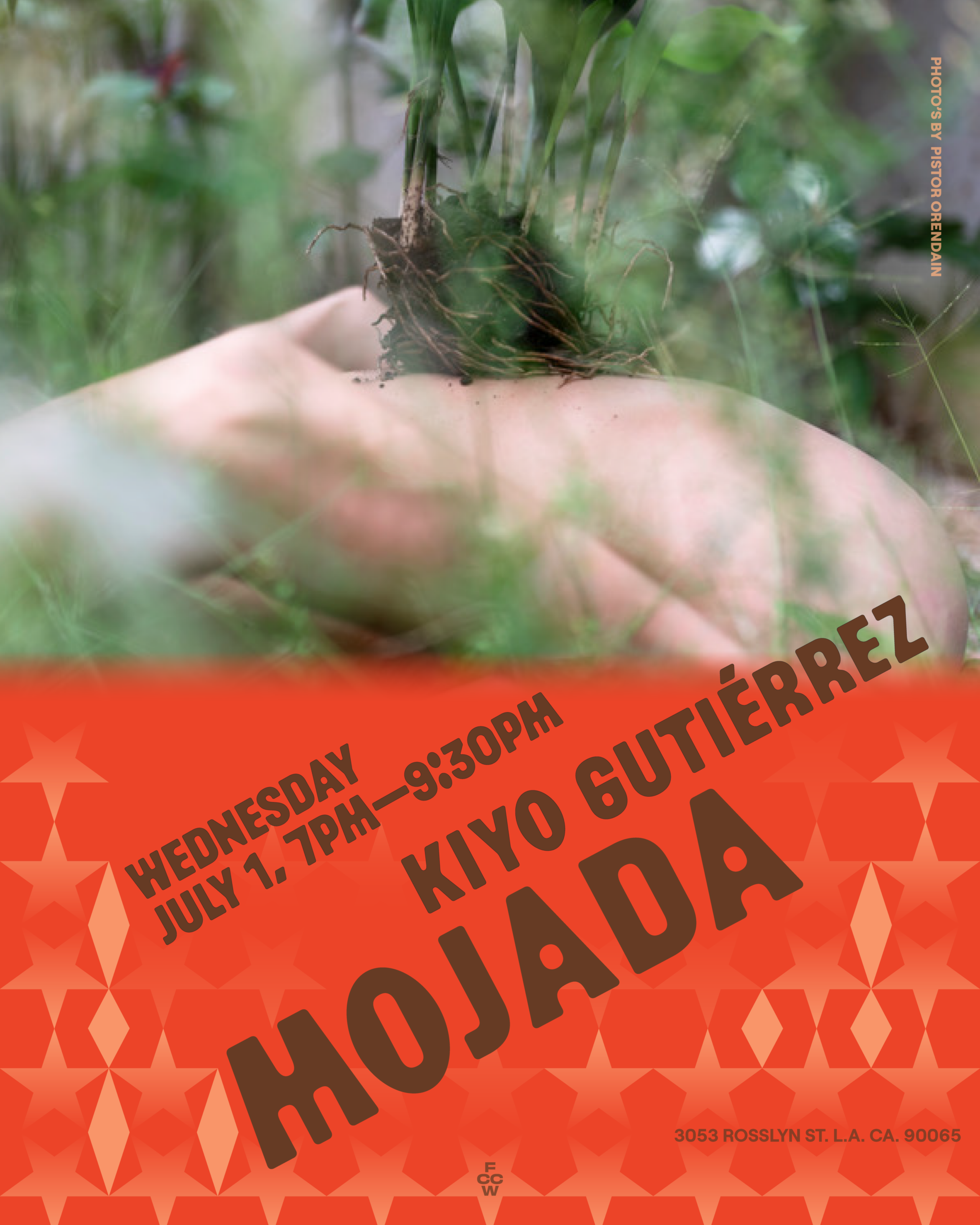
Wednesday, July 1, 7–9:30PM
FCCW: 3053 Rosslyn St. LA, CA 90065
Info on our space here
Max Participants: 40
Free
In mojada, Spanish for “wet,” Kiyo Gutiérrez stages the body as both archive and infrastructure, bearing the sedimented histories of migration, labor, and racialized language. Drawing from Mesoamerican cosmovision, in which humans are made of maize, the work situates the body within a cosmology of land-based kinship rather than nationalist borders. Referencing the slur “wetback” and its violent immigration history, the performance transforms water from a mark of criminalization into a force of memory, endurance, and regeneration.
Special thanks to Metabolic Studio and Lauren Bon for the maize seeds from Not A Cornfield, planted on Mother’s Day 2026 within the ancestral homelands of the Gabrielino/Tongva Nation and near the Arroyo Seco. Grown from these seeds, the young maize plant appearing in mojada emerges from a longer lineage of ecological remediation and land-based practice, carrying forward ongoing cycles of cultivation, migration, and return to the land. Lauren Bon’s Not A Cornfield (2005–2006) existed for one agricultural cycle: a million kernels of corn sown, tended, and harvested to remediate a brownfield site alongside the Los Angeles River. At the time, even though water from the LA River was considered surplus and allowed to flow out to sea, California water laws prohibited diverting that water to nourish crops, extracting toxicity from the soil. That changed with Bending the River. Since 2005, Metabolic Studio has continued growing corn as an ongoing ecological and cultural practice that has helped heal soil at both Un-development 1 and Un-development 2, carrying forward the legacy of remediation, renewal, and relationship to land through each agricultural cycle.
Flyer photo credit: Pistor Orendain
Performance Documentation
Text by Patty Gone, Photos by Amina Cruz
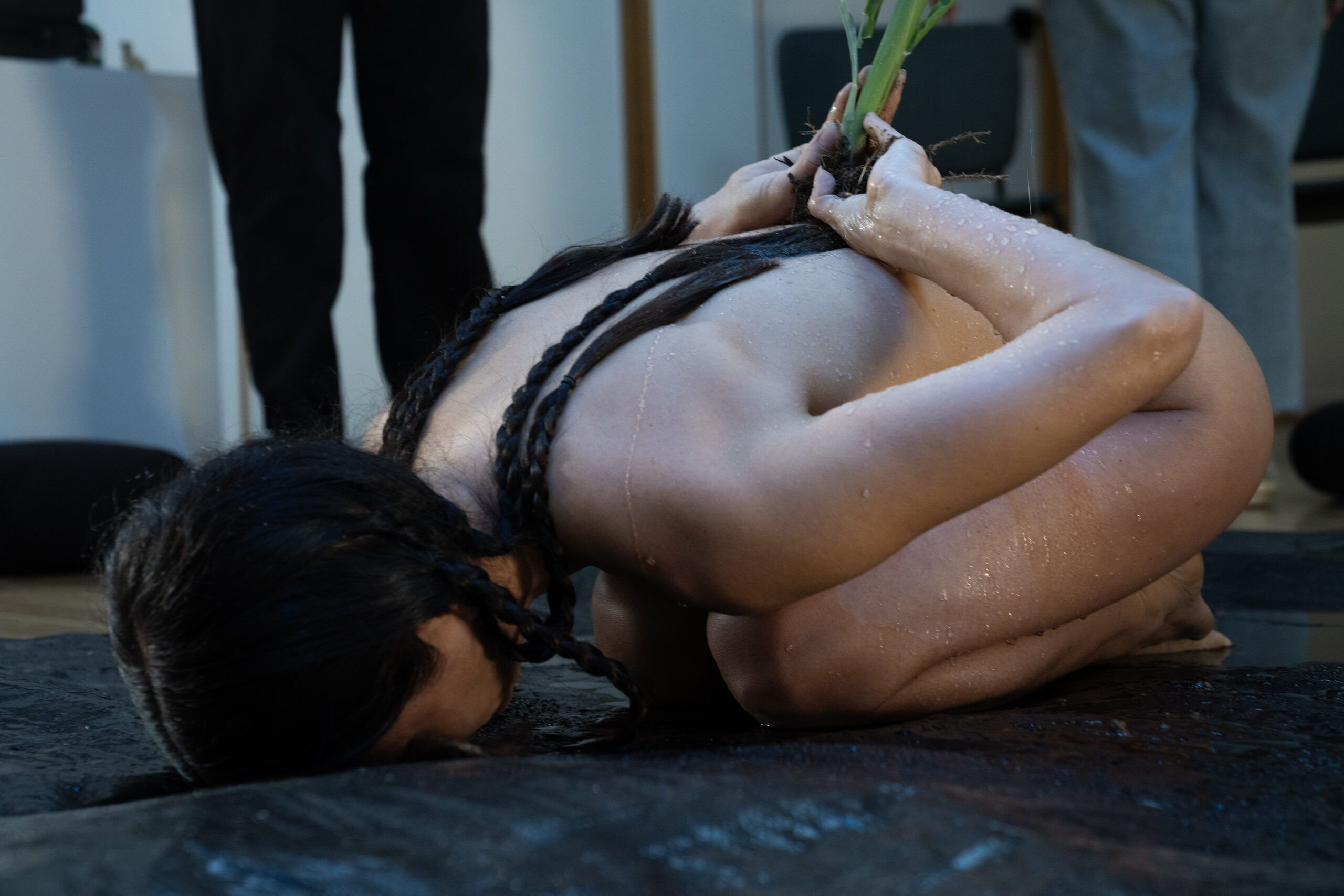
Ice melts onto Kiyo Gutiérrez’s bare back. She lies in child’s pose, nude and face down on the gallery floor beneath two massive ice blocks, suspended from the ceiling. Her arms wrap around her back as if she’s captured, a prisoner, but her hands hold a tiny plant with six leaves. This two-month-old maize plant may one day be a corn stalk, growing taller than your average person, but for now, it’s living in the handful of soil between Gutiérrez’s fingers, and watered by drips from above.
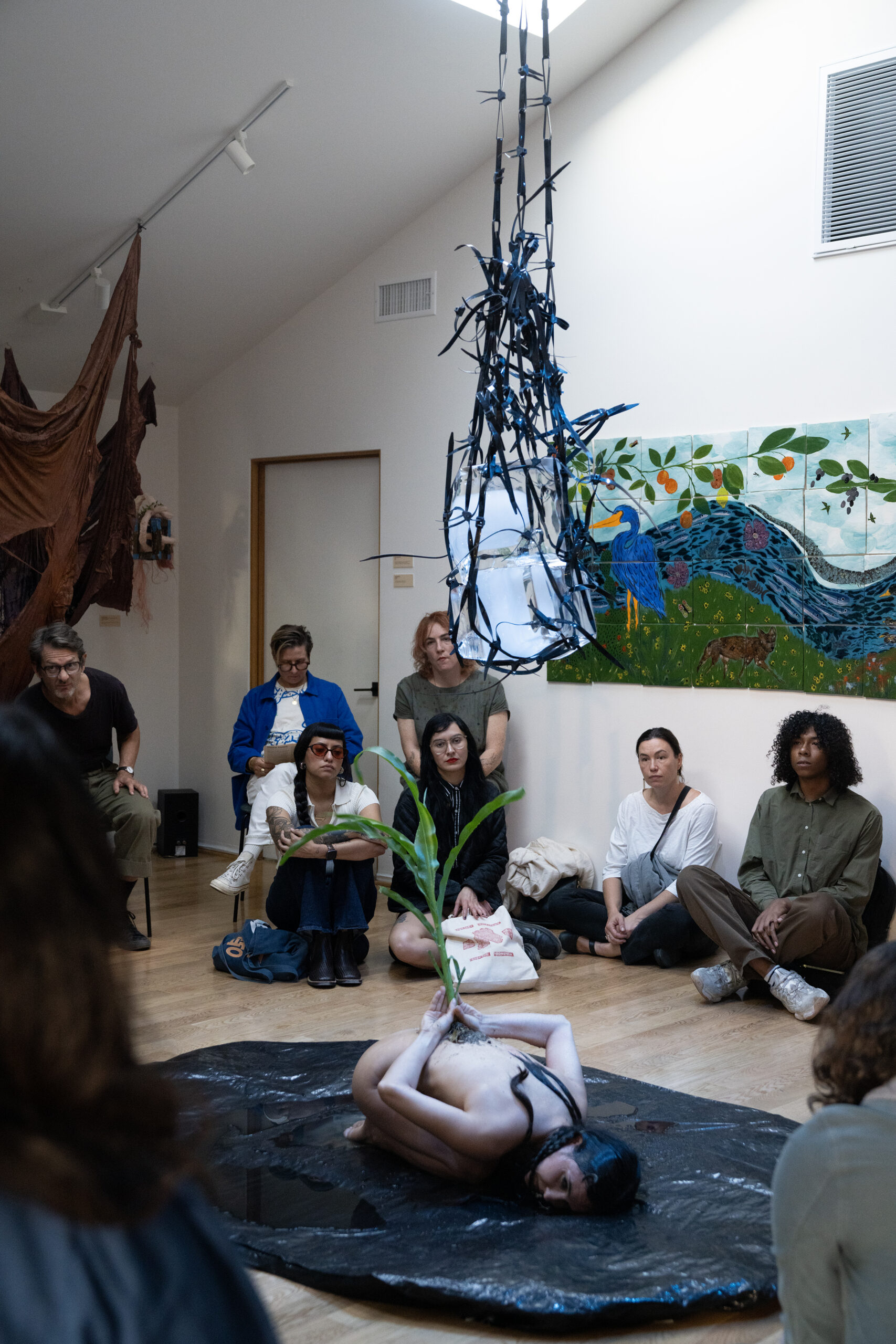
The audience fills in around her in a silent circle, each one of them with a different vantage point. Some see the back of her head, her ponytail, and her
mid-back where the maize rests, while some see her buttocks and bare feet, its toes and soles crinkled in effort. Others see her breasts flattened by her knees. As time erodes, so does Gutiérrez’s ability to keep still. She can’t help it. Her hands tremble from the bending of her shoulders and elbows unnaturally backwards.
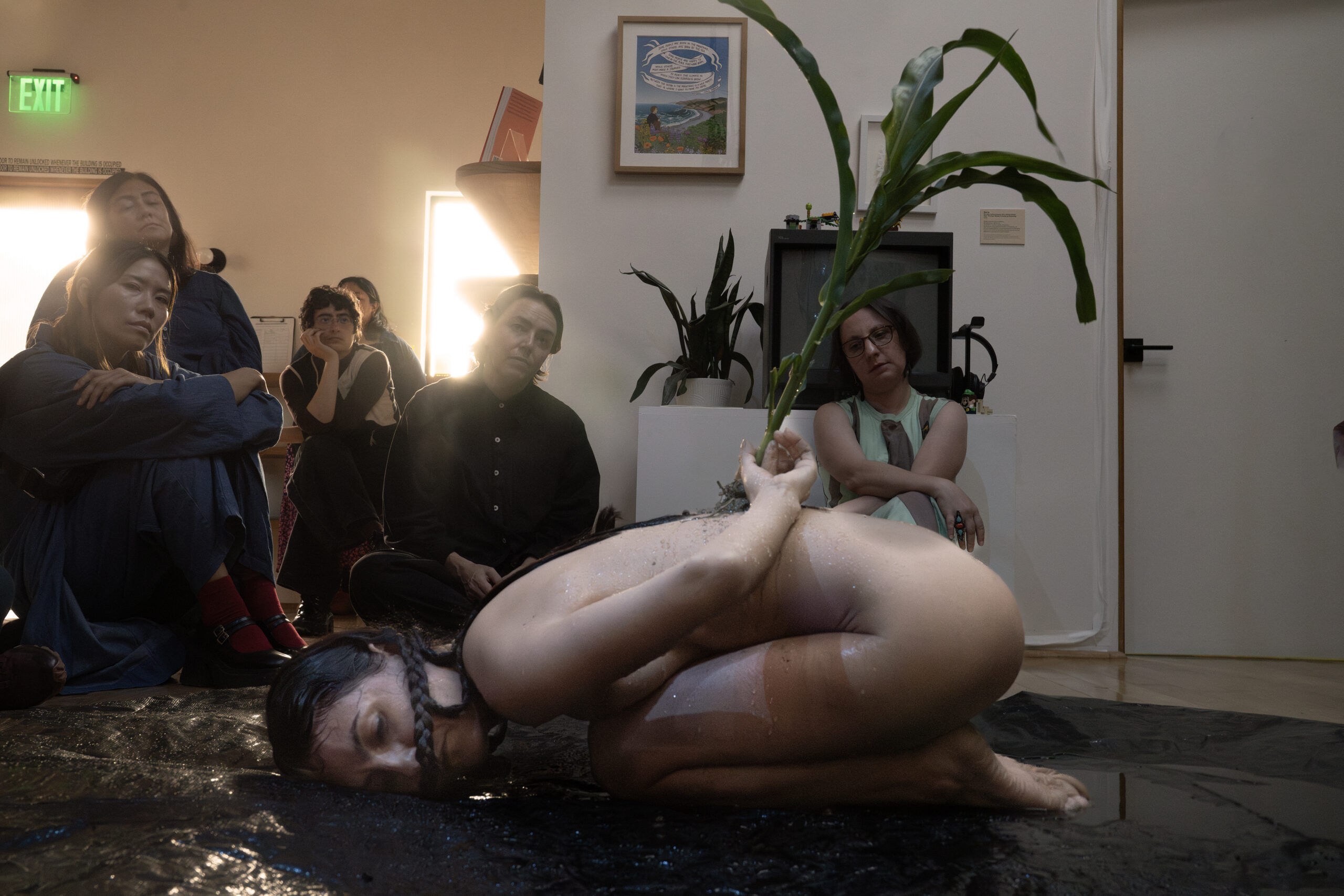
As her fingers move, bits of soil spill onto her back, and she can’t keep the maize fully upright. It tilts and wavers. Drops of water hit it or miss it, often landing on her shoulder and sliding down, a tiny river. The drops form from four different spots on the cube. They accumulate on the skin and reunite witheach other on the oval polyethylene plastic spread out on the floor beneath her body.
The runoff pools. Her ponytail rests in a puddle; her legs and knees become more and more submerged.
What initially, when one first entered, appeared to be a pristine tableau of natural elements (body, plant, water) now shows its wear. After looking for ten minutes, fifteen, time is perceivable by clocking how these elements affect each other. The pool at her feet takes on a brown parlor as drips mix with the dirt from her back. Her breathing gets heavier and audible for the first time, and she releases a large exhale directly into a puddle, her air scattering the water.
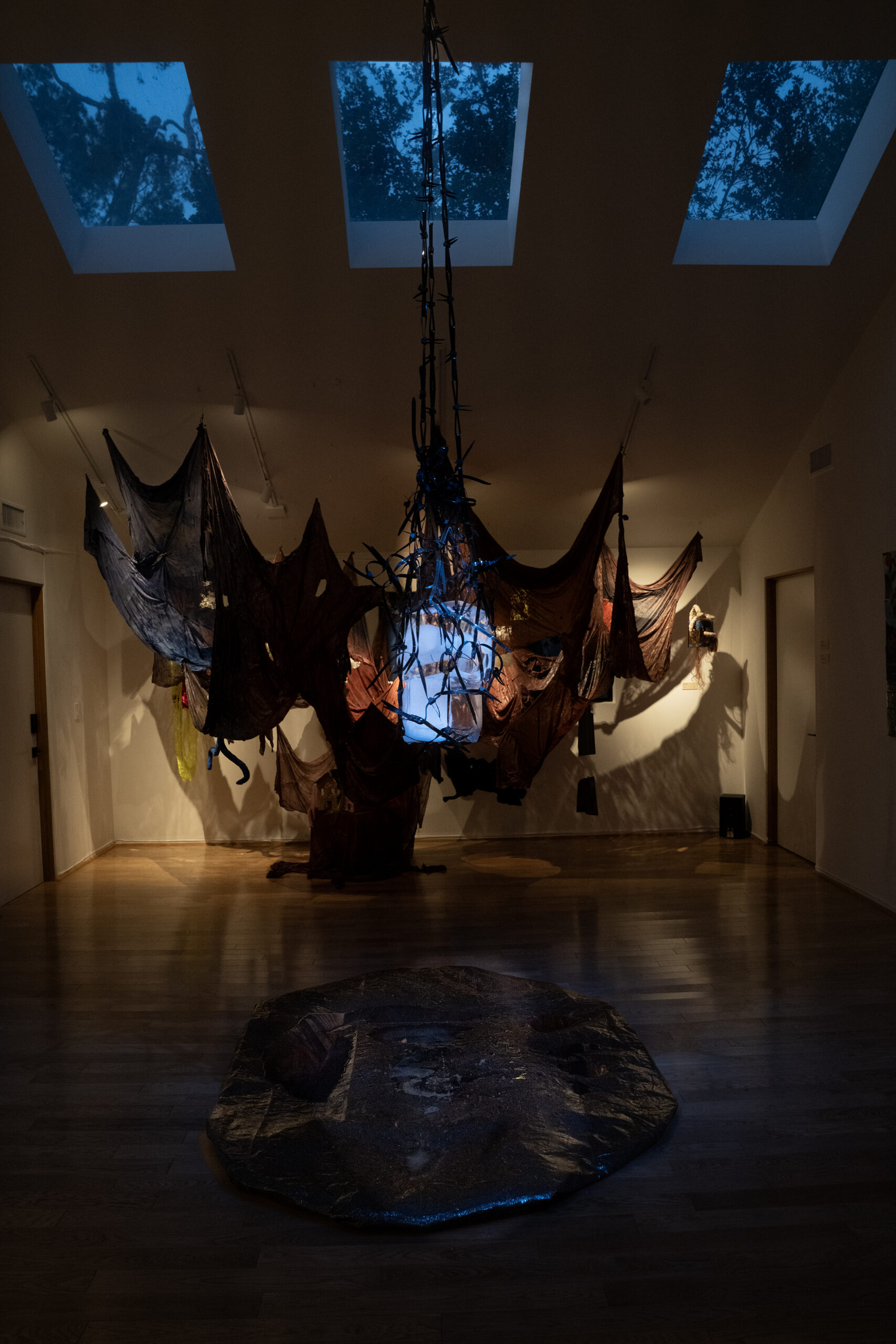
The ice changes too. The two blocks, stacked atop each other, are suspended four or five feet off the ground by a bramble of thick black zip ties, as if claws were cradling the ice. The amount of wet plastic and their arrangement in this dense and wild cluster leads them to resemble a tangle of black patent leather. They branch out sharply in all directions, a spiked torture device, transporting our setting away from a gallery and closer to a secret military prison or kink dungeon. As the ice liquifies, the black straps impress themselves upon the blocks, carving grooves and turning what were once perfect rectangles into records of natural erosion.
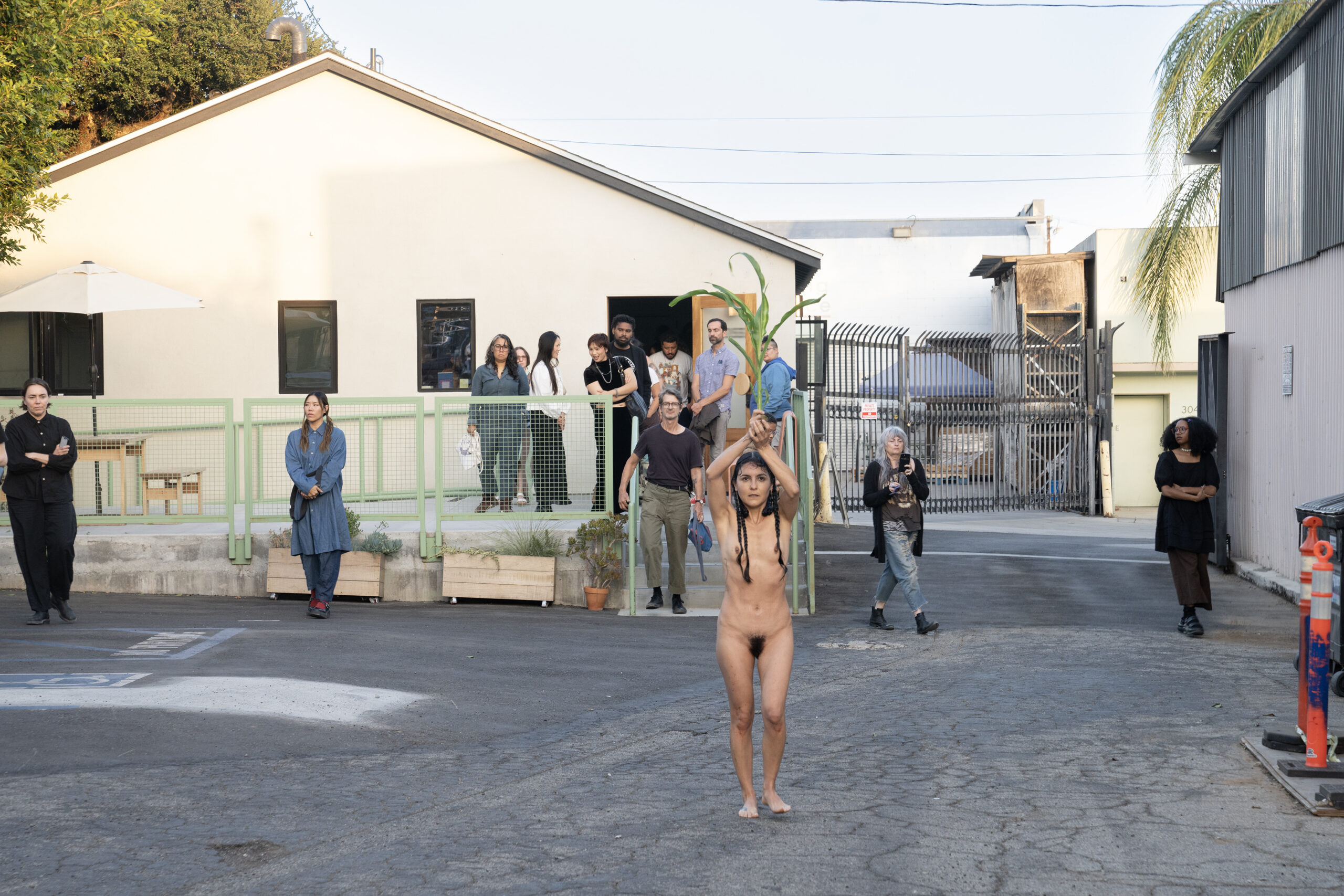
Below, on Gutiérrez’s body, droplets fracture into tiny dots. Her hair and back glisten with wet specks that appear gold or silver from certain angles in the fading evening light. She opens her mouth and winces, arching her back in discomfort. Ughhhh, she grimaces and the plant teeters. She makes eye contact. She sits back onto her heels, moves the maize to the front of her body, and stands incrementally, with care, allowing a moment for the sleeping parts of her body to wake up. She walks through us and out of the gallery. Holding the plant above her head, she’s already down the stairs and into the parking lot. We all follow her, or maybe chase her. We can’t keep up. Wet soil runs down her behind as she turns another corner.
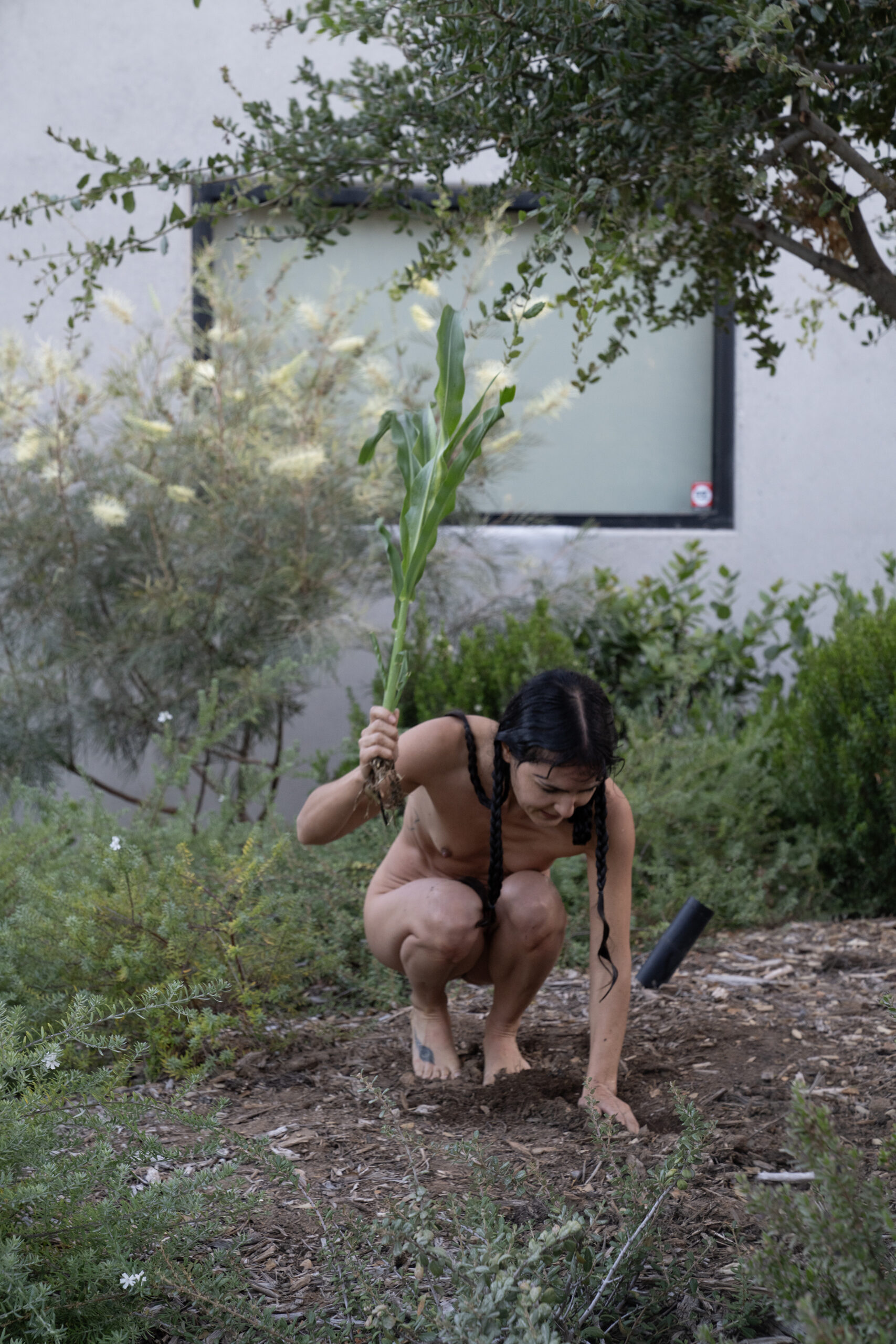
In the garden, she ascends a small mound and pauses to face us. She crouches and digs a hole with her bare left hand, the plant cradled in her right. When she decides the new home is ready, she places the plant down, covering its roots with the dry July dirt. She bows to us. Her hands, having completed their labor, press together in prayer.
In one way, the performance ends and we clap. In another, the maize is still growing, and may one day sprout corn. The ice in the gallery is still melting in the heat, the black plastic still indenting the natural world. Wrapped in a maroon robe, Gutiérrez disappears to get warm.
ABOUT THE ARTIST
Kiyo Gutiérrez is a Mexican multidisciplinary artist. Trained in history, she turned to performance to explore the body’s potential as a tool of resistance. Her work emerged as a response to Mexico’s brutal realities: femicide, disappearances, and environmental devastation. Her ritual-performances often integrate archival research, sculpture, textile, sound and audience participation. Her work reexamines the construction of colonial history, uncovering how bodies and materials themselves bear the traces of extraction, exploitation, resistance and transformation. She is interested in the possibility of multispecies alliances and has collaborated with damaged bodies of water, pollinators and burnt forests. Kiyo performs in public spaces and has participated in Performance Festivals and exhibitions in México, Brasil, Colombia, Bolivia, Spain, Italy and the United States. She has participated in Irrational Exhibits 13: Debates, an editorial project for Colección Cisneros, and is an alum of Georgetown University’s Laboratory for Global Performance and Politics. Kiyo is a recipient of the Franklin Furnace Fund, the Macomber Travel Grant, the Fulbright Scholarship, and was nominated for the Gilder/Coigney International Theatre Award. She received her MFA in Fine Arts at the Roski School of Arts of the University of Southern California.